

Your roof can look fine from the street and still be quietly deteriorating. For homeowners and property managers in Southern Ontario, the signs roof needs professional cleaning are often subtle enough to miss until the damage is already done. Moss, algae, and debris don’t just affect curb appeal. They trap moisture, lift shingles, and accelerate wear in ways that cost far more to fix than a professional wash would have. Knowing what to look for, and what each sign actually means, is the difference between a simple cleaning and a premature roof replacement.
Key takeaways
| Point | Details |
|---|---|
| Biological growth signals moisture damage | Moss, algae, and lichen actively retain moisture and lift shingles, making professional cleaning urgent rather than optional. |
| Granule loss points to accelerated ageing | Heavy granule deposits in your gutters indicate shingle deterioration that is often worsened by biological growth. |
| Gutters reveal roof health | Blocked or debris-filled gutters are a direct roof cleaning indicator and a warning sign for ice dam risk in Ontario winters. |
| Indoor symptoms have outdoor causes | Musty odours and water stains inside your home can trace back to moisture trapped by roof surface growth. |
| Soft washing protects shingles | Professional soft-wash methods remove organisms at the root without stripping granules, unlike pressure washing. |
1. Signs roof needs professional cleaning: biological growth
The most reliable roof cleaning indicator on any Ontario home is visible biological growth. Moss, algae, and lichen are not cosmetic problems. They are active organisms that feed on your roofing materials and hold moisture against the surface continuously.
Algae, specifically Gloeocapsa magma, appears as dark grey or black streaking across shingles. It is often mistaken for simple dirt or oxidation. Moss grows in thick, green patches and is most common on north-facing slopes or areas shaded by trees. Lichen is the most stubborn of the three. It bonds chemically to shingle granules and requires professional treatment to remove without causing additional damage.
Southern Ontario’s climate creates ideal conditions for all three. Humid summers, frequent rainfall, and shaded lots mean moss and algae thrive in moist environments year-round. Once established, long-term moss retention leads directly to shingle lifting and decay beneath the growth.
Pro Tip: Asphalt shingles in shaded or wet areas should be professionally cleaned every one to two years. Waiting longer allows organisms to root deeper into the shingle surface, making removal more difficult and increasing the risk of damage.
The correct professional approach involves applying a low-concentration chemical treatment, typically Sodium Hypochlorite, and allowing it to dwell before a controlled rinse. This kills organisms at the root. Understanding the difference between soft washing and pressure washing explains why high-pressure methods are avoided. Pressure washing strips granules and shortens the roof’s service life considerably.
2. Shingle damage, granule loss, and lifting edges
Physical deterioration of your roofing material is one of the clearest professional roof washing signs available. You do not need to climb onto the roof to spot several of these indicators.
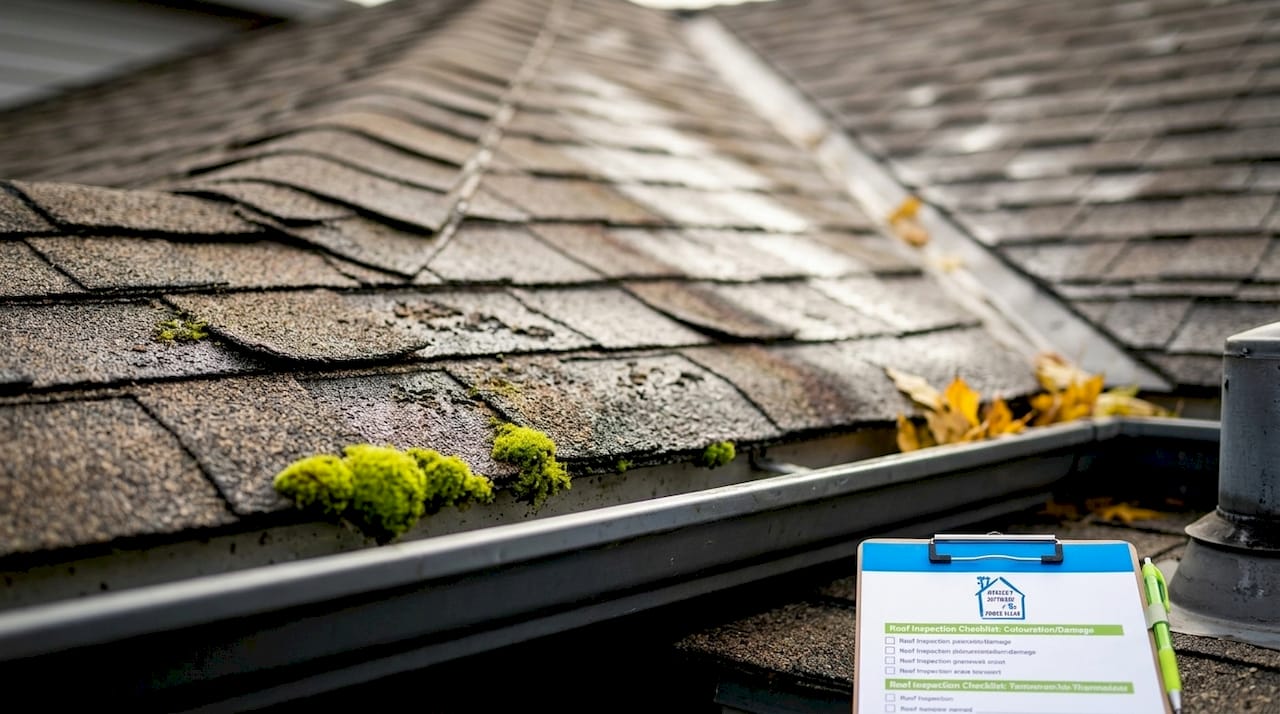
Start with your gutters after a rainfall. Granule deposits in gutters signal accelerated shingle ageing, and this process is frequently worsened by biological growth sitting on the surface. Granules are the protective outer layer of asphalt shingles. Once they shed in quantity, the shingle underneath is exposed to UV degradation and moisture penetration.
From the ground, look for shingles that appear curled at the edges or cupped in the centre. These shapes indicate that moisture has worked beneath the shingle, often because moss roots have physically lifted the material. Cracked or brittle-looking shingles in isolated patches also warrant attention, particularly after a winter season.
When you see these physical signs alongside visible biological growth, the two problems are almost always connected. Professional cleaning with soft wash removes the organisms causing the lifting while protecting the remaining granule surface. In some cases, cleaning reveals shingles that are too far deteriorated to recover, which is when a conversation about roof cleaning versus replacement becomes necessary.
Annual pre-winter inspections are recommended for Southern Ontario homes specifically because catching loose or lifting shingles before freeze-thaw cycles begin prevents far more costly repairs in spring.
3. Gutter and drainage symptoms
Your gutters are a direct window into the condition of your roof surface. When they are consistently overfilled, clogged, or carrying unusual debris, that is your roof communicating a maintenance need.
Moss fragments, shingle granules, and organic debris washing into gutters during rain indicate active surface deterioration above. Clogged gutters trap water and lead to fascia damage, soffit rot, and water intrusion at the roofline. In Southern Ontario winters, this trapped water becomes the starting point for ice dams.
Ice dams form when heat escaping through the roof melts snow unevenly, and the meltwater refreezes at the cold eave edge. Ontario freeze-thaw cycles accelerate roof wear significantly, and blocked gutters are a primary contributing factor. Clearing your gutters in isolation does not solve the problem if the roof surface is still generating the debris causing the blockage.
Pro Tip: Schedule roof cleaning and gutter cleaning together. Cleaning the roof surface first and then clearing the gutters removes the source of debris and the accumulated result in a single visit, which is more cost-effective and more thorough than treating each separately.
Coordinating these two services improves water management across the entire roofline and reduces the frequency of future blockages. Moss clusters in roof valleys and along edges are particularly productive sources of gutter debris and should be targeted specifically during any professional cleaning.
4. Indoor and attic signs linked to roof moisture
Some of the most telling how-to-tell-if-roof-is-dirty signals are found inside your home, not on the exterior surface. If you notice a persistent musty odour in your attic or upper ceiling areas, that is worth investigating before attributing it to general humidity.
Water stains on interior ceilings or walls, particularly near the roofline, indicate that moisture is penetrating from above. Daylight visible through attic boards is an obvious warning, but discolouration and soft spots in attic insulation are subtler signs that moisture has been present for some time.
The connection to roof surface conditions is direct. Biological growth on the exterior retains moisture against the shingle surface continuously. Over time, that moisture works through compromised shingles and flashing into the structure below. Musty odours and water stains often stem from roof moisture problems that a professional inspection can trace back to the surface.
Cleaning alone will not resolve mould or water intrusion if the roof surface is still compromised. Source control matters. A professional assessment should identify whether the moisture pathway is biological growth, damaged flashing, or failing shingles before any remediation begins.
If you are seeing interior symptoms, the appropriate response is a professional roof inspection combined with cleaning, not cleaning alone. Addressing the surface growth removes the moisture-retaining cause, while the inspection confirms whether structural repairs are also required.
5. Discolouration, staining, and streaking patterns
Dark streaking across your shingles that runs vertically in the direction of water flow is almost always Gloeocapsa magma algae. It is not dirt. It will not wash off in rain. It spreads from spore to spore across the roof surface and darkens progressively over time.
Green or yellow-green patches in shaded areas indicate moss in early to mid-growth stages. These patches feel spongy if you can safely access the area. White or grey crusty patches that appear fused to the shingle surface are lichen, the most difficult organism to remove and the one most likely to cause permanent granule loss if treated incorrectly.
Uneven discolouration across sections of the roof, where one slope appears significantly darker than another, usually reflects differences in sun exposure and moisture retention. The darker, shadier slope is typically the one requiring more urgent attention.
These visual patterns are reliable roof cleaning indicators precisely because they follow predictable growth behaviour. Recognising the pattern type helps a professional determine the appropriate treatment concentration and method before arriving on site.
6. Age of the roof and time since last cleaning
Roof maintenance cleaning tips consistently point to one factor that homeowners overlook: elapsed time since the last professional cleaning. If you cannot recall when your roof was last cleaned, that is itself a sign worth acting on.
For asphalt shingles in Southern Ontario, where shade and humidity are common, cleaning every one to two years is standard practice. A roof that has gone five or more years without cleaning in this climate almost certainly has biological growth present, even if it is not yet obvious from the street.
Older roofs, particularly those approaching the 15 to 20 year mark, are more susceptible to accelerated deterioration from biological growth because their granule layer is already thinning naturally. A professional cleaning at this stage can extend the roof’s useful life significantly by removing the organisms accelerating that thinning process.
7. Comparison of signs, urgency, and recommended responses
Different roof conditions carry different levels of urgency. This comparison helps you prioritise what you are seeing and decide on the appropriate next step.
| Sign observed | Risk level | Urgency | Recommended action |
|---|---|---|---|
| Dark algae streaking | Moderate | Schedule within 3 months | Professional soft-wash cleaning |
| Moss patches (early stage) | Moderate to high | Schedule within 4 to 6 weeks | Soft-wash with root treatment |
| Lichen growth | High | Schedule promptly | Professional cleaning with assessment |
| Granule loss in gutters | High | Inspect and clean immediately | Cleaning plus shingle inspection |
| Lifting or curling shingles | High | Immediate professional assessment | Cleaning and repair evaluation |
| Interior water stains | Critical | Immediate | Professional inspection and cleaning |
| Clogged gutters with debris | Moderate | Schedule within 2 to 4 weeks | Coordinated roof and gutter cleaning |
When cleaning alone is sufficient, the roof surface shows biological growth without significant physical shingle damage. When repair is also needed, you will typically see a combination of lifting shingles, granule loss, and interior moisture signs together. A professional assessment after cleaning clarifies which category your roof falls into.
My honest take on when homeowners wait too long
I have seen a consistent pattern over years of working on Southern Ontario roofs. Homeowners treat moss and algae as an appearance issue and put off cleaning until something more serious forces the conversation. By that point, the shingles underneath have often been lifting for a season or two already.
The other mistake I see regularly is DIY pressure washing. It looks effective because the surface comes clean immediately. What it actually does is blast granules off the shingle surface, which accelerates ageing by years in a single afternoon. The professional soft-wash method takes longer to show results because the chemical treatment kills the organism at the root rather than physically removing it. That is exactly why it works without damaging the shingle.
My practical advice for Southern Ontario homeowners is to build roof cleaning into your pre-winter checklist, not your spring cleaning list. Addressing biological growth and clearing gutters before freeze-thaw season begins means your roof goes into winter in the best possible condition. Waiting until spring means it has already endured a full winter with compromised drainage and active growth.
If you are unsure whether what you are seeing is cosmetic or structural, get a professional assessment. The cost of an inspection is negligible compared to what undetected moisture damage costs to remediate.
— Felix
How Mercerssoftwashpowerclean can help with your roof
If any of the signs described in this article look familiar, Mercerssoftwashpowerclean provides professional roof washing services across Southern Ontario using soft-wash methods that protect your shingles while removing moss, algae, lichen, and staining at the source. The team also offers gutter cleaning as a coordinated service, addressing both the roof surface and the drainage system in a single visit. Whether you are managing a residential property or a commercial building, Mercerssoftwashpowerclean brings the regional knowledge and proper equipment to handle Ontario’s specific climate challenges. Contact the team for a quote and get your roof assessed before the next season creates more work than necessary.
FAQ
What are the most common signs a roof needs cleaning?
The most common signs are dark algae streaking, green moss patches, lichen growth, granule deposits in gutters, and discolouration on shaded roof slopes. Any one of these indicates biological growth that requires professional treatment.
How often should roofs in Southern Ontario be cleaned?
Asphalt shingles in Southern Ontario should be professionally cleaned every one to two years, particularly on shaded or north-facing slopes where moss and algae establish quickly due to moisture and limited sun exposure.
Can I pressure wash my own roof instead of hiring a professional?
Pressure washing strips granules from asphalt shingles and shortens the roof’s service life. Professional soft-wash cleaning uses low pressure and a chemical treatment to remove organisms safely without damaging the shingle surface.
Do indoor water stains mean my roof needs cleaning or replacing?
Interior water stains indicate moisture is entering through the roof, which often traces back to biological growth or damaged shingles. A professional inspection determines whether cleaning, repair, or both are required to address the source.
What happens if I ignore moss and algae on my roof?
Moss and algae retain moisture continuously against the shingle surface, which lifts shingles over time and accelerates granule loss. Left untreated, this leads to premature shingle failure and potential water intrusion into the structure below.
Recommended
- Roof Cleaning Vs Roof Replacement: Which Is Better? – Mercer’s Softwash & Power Clean Inc. | Pressure Washing Service
- Roof Washing Service – Mercer’s Softwash & Power Clean Inc. | Pressure Washing Service
- Residential Services – Mercer’s Softwash & Power Clean Inc. | Pressure Washing Service
- How Often Should You Wash Your House Exterior In Port Hope? – Mercer’s Softwash & Power Clean Inc. | Pressure Washing Service


