

Most homeowners assume pressure washing is the go-to solution for any dirty exterior. More pressure equals cleaner results. That logic makes sense until you learn that high-pressure washing on asphalt shingles strips protective granules and voids your manufacturer warranty. Choosing between soft washing vs pressure washing is not about which method is stronger. It’s about matching the right method to the right surface. Get that wrong, and you’re paying for repairs instead of cleaning. This guide breaks down exactly how each method works, where each belongs, and how to choose confidently.
Key takeaways
| Point | Details |
|---|---|
| PSI determines the method | Soft washing runs at 100–500 PSI; pressure washing operates between 1,300 and 4,000 PSI. |
| Surface type drives the decision | Roofs, vinyl siding, and stucco need soft washing; concrete, metal, and heavy equipment suit pressure washing. |
| Soft washing lasts longer | Soft wash results on residential roofs can last 4–6 years versus pressure washing which must be repeated as dirt returns. |
| Wrong method causes real damage | Pressure washing delicate surfaces risks water intrusion, stripped granules, and voided warranties. |
| Professional assessment matters | Hiring a trained technician protects your surfaces and gives you results that hold up over time. |
How soft washing and pressure washing actually differ
The fundamental difference between soft washing and pressure washing comes down to what does the cleaning work: chemistry or force. Understanding this distinction will change the way you think about every exterior surface on your property.
Soft washing uses low pressure typically between 100 and 300 PSI, paired with specially formulated chemical solutions to kill and remove organic growth, algae, mildew, and staining at the source. Pressure washing, by contrast, operates between 1,300 and 4,000 PSI and relies on mechanical force to blast surface contamination away. One method dissolves the problem; the other physically removes it.
The equipment used for each method looks similar on the surface, but the setup differs considerably. The same machine can handle both methods when configured with the appropriate nozzles and chemical injection systems. Soft washing typically employs wide-angle or downstream injection nozzles to deliver cleaning solutions at low velocity, while pressure washing uses narrow-angle, high-velocity nozzles to concentrate force on tough surfaces. Professional-grade soft wash systems use 12V electric or gas-powered pumps that maintain high volume at precisely controlled low pressure, enabling chemical killing of organic growth without the risk of pressure-related surface damage.
Water flow rate, measured in gallons per minute (GPM), also plays a role in how effective and efficient each method is. Pressure washing at high GPM rates removes heavy soiling quickly from durable surfaces. Soft washing prioritises chemical dwell time over water volume, which is why it can achieve thorough results while using significantly less water overall.
| Feature | Soft washing | Pressure washing |
|---|---|---|
| PSI range | 100–500 PSI | 1,300–4,000 PSI |
| Cleaning mechanism | Chemical solutions | Mechanical force |
| Best for | Delicate surfaces, organic growth | Hard surfaces, heavy grime |
| Water usage | Lower (biodegradable chemicals) | Higher volume |
| Result longevity | 4–6 years (roofs), 12–18 months (commercial) | Until re-contamination |
Pro Tip: If you’re unsure which method applies to a surface, check what the primary contaminant is. Biological growth like algae, mould, and mildew respond to chemistry. Grease, mud, and oil on hard surfaces respond to pressure.
Which surfaces suit each method
This is where most property owners make costly mistakes. Choosing the wrong method for a surface does not just produce poor results. It can cause irreversible damage.
Soft washing is the correct choice for asphalt shingles, vinyl siding, painted wood, stucco, EIFS cladding, and window screens. These surfaces are either structurally fragile, have protective coatings that can be stripped, or are designed in ways that allow high-pressure water to force its way behind the material and cause moisture damage. Soft washing is safe for vinyl siding specifically because the low-pressure application prevents water intrusion behind the panels, which is a documented risk when pressure washing is applied to these surfaces.
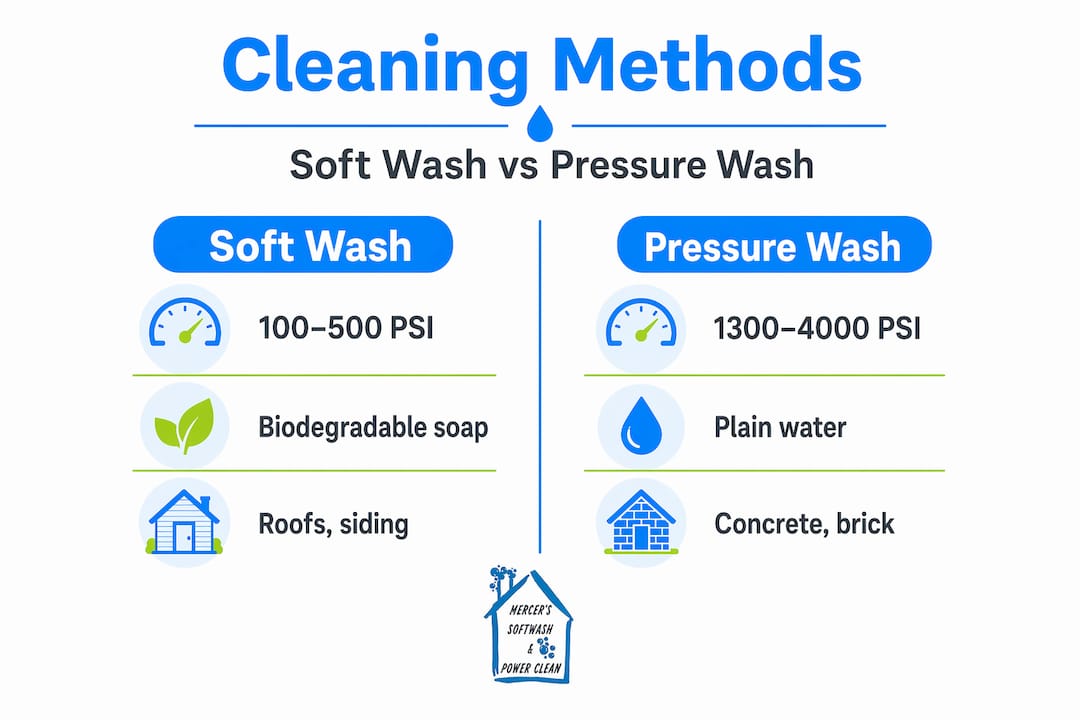
Roofing deserves particular attention. Soft washing is the industry-standard method for shingle preservation, and for good reason. Asphalt shingles rely on mineral granules to deflect UV radiation and manage water runoff. A high-pressure stream removes those granules permanently, accelerating shingle deterioration and, in many cases, voiding the manufacturer warranty. The algae, lichen, and moss that collect on roofs are biological organisms, and they respond far more effectively to a sodium hypochlorite-based solution than to mechanical scrubbing.
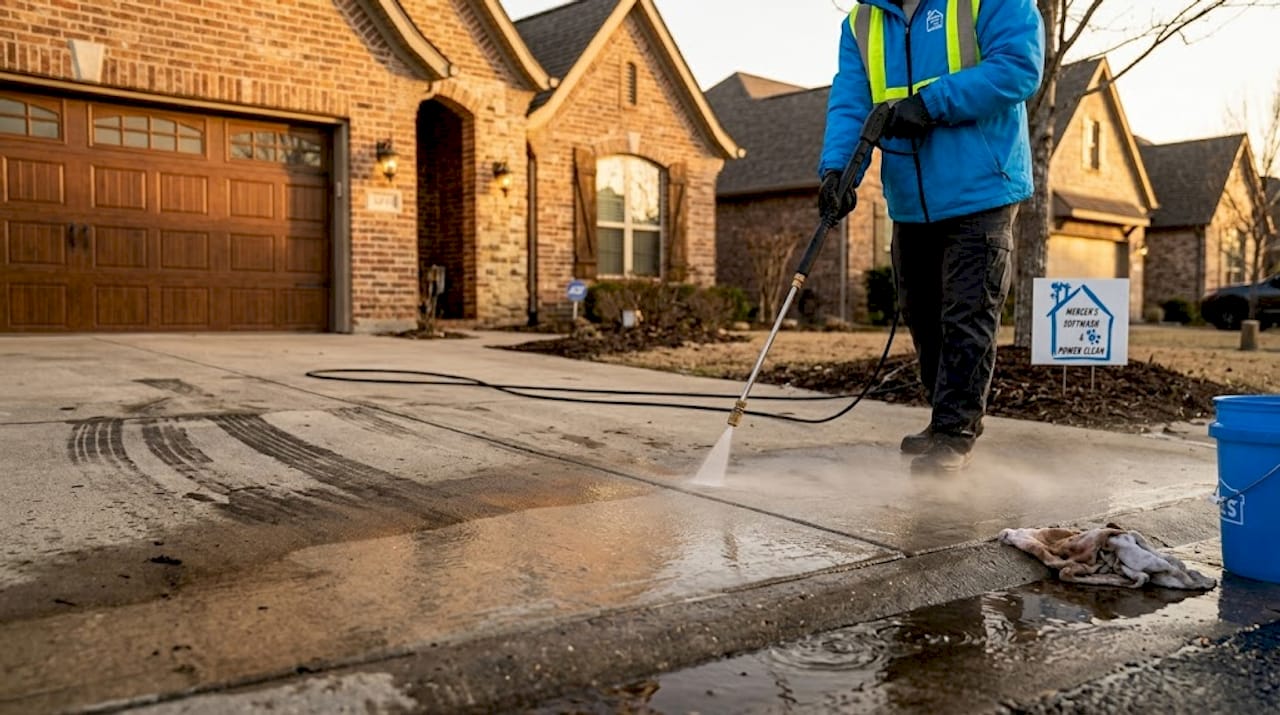
Pressure washing, on the other hand, is highly effective and appropriate for concrete driveways, interlock pavers, brick retaining walls, metal surfaces, dumpsters, and heavy commercial equipment. Pressure washing excels on concrete where grease, oil, gum, rust staining, and compacted dirt cannot be dissolved by chemistry alone and require the physical shear force of a high-pressure stream to release from the surface.
When it comes to the difference between a commercial softwash vs pressure wash on buildings, the scale and surface composition change the calculus. Large commercial facades with metal cladding or pre-cast concrete can often withstand pressure washing at appropriate settings. However, commercial properties with EIFS panels, painted brick, or older masonry require soft washing to avoid etching, staining, or water infiltration that becomes a structural maintenance issue.
Pro Tip: For softwash vs pressure wash siding decisions, always identify the siding material first. Vinyl and painted wood require soft washing without exception. Brick and concrete block can generally tolerate controlled pressure washing at lower PSI settings with appropriate nozzle selection.
Cost, water use, and how long results last
Cost is often the first question homeowners ask, and it helps to understand what drives the price difference between the two methods before comparing quotes.
Professional exterior cleaning typically costs between $250 and $500 on average for residential properties, with complex or large projects reaching $1,000 and beyond. Soft washing tends to be priced at the higher end of this range not because the equipment is more expensive, but because the chemical solutions, the technical knowledge required for correct dilution and application, and the labour skill involved all contribute to the overall cost. A technician who understands sodium hypochlorite ratios, surfactant combinations, and dwell times is providing a significantly more specialised service than someone running a basic pressure washer.
Water usage is another meaningful consideration. Soft washing uses 60–75% less water than traditional pressure washing and relies on biodegradable chemical formulations. That combination makes soft washing the more environmentally responsible choice for regular maintenance, particularly in regions where water conservation or runoff restrictions apply.
The most compelling argument for soft washing on appropriate surfaces is longevity. Soft wash results last 4–6 years on residential roofs because the chemicals kill the biological organisms at the root rather than washing them off temporarily. Pressure washing, by contrast, removes visible contamination but does not kill the underlying spores or root systems, meaning regrowth occurs significantly faster. On commercial properties, soft washing results typically hold for 12 to 18 months.
| Factor | Soft washing | Pressure washing |
|---|---|---|
| Average cost | $300–$600+ (residential) | $200–$400 (residential) |
| Water usage | 60–75% less | Higher |
| Environmental impact | Biodegradable chemicals | Water-intensive |
| Result duration | 4–6 years (roofs) | Until re-contamination |
| Skill requirement | Higher (chemical knowledge) | Moderate |
Pro Tip: In Southern Ontario’s climate, where freeze-thaw cycles, humidity, and tree canopy promote rapid algae and mould growth, scheduling a soft wash every 2–3 years for roofs and siding gives you the best balance of cost and surface protection.
Risks of using the wrong method
The risks of misapplying either method go well beyond a less-than-perfect finish. In some cases, the damage is permanent and expensive.
Using pressure washing on a roof is the most common and costly mistake homeowners make. Beyond stripping granules and voiding warranties, high-pressure water can lift shingles, drive moisture under the flashing, and create the conditions for interior water damage. By the time the damage becomes visible inside the home, the repair bill has already grown considerably.
On siding, forced water intrusion is a serious concern. Vinyl siding is designed with overlapping panels that manage water flow under normal conditions. A high-pressure stream directed into those overlaps drives water behind the panels and into the wall assembly, where it promotes mould growth and wood rot. Pressure washing risks forcing water behind siding in ways that are not visible until significant damage has occurred.
Soft washing carries its own risks when handled without proper training. Sodium hypochlorite, the active ingredient in most soft wash solutions, requires careful handling, correct personal protective equipment (PPE), and precise dilution. Correct PPE use for sodium hypochlorite applications is not optional. Incorrect concentration can bleach or discolour surrounding plants, stain surfaces it was not intended to clean, or cause skin and eye irritation. This is not a casual DIY project.
Common operator mistakes to avoid include directing a pressure washer upward at siding or shingles, using zero-degree nozzles on any painted or coated surface, skipping a test patch before soft washing, applying soft wash solutions in direct sunlight which causes them to dry too quickly, and failing to pre-wet surrounding vegetation before chemical application. Any one of these errors can turn a routine cleaning job into a repair project.
Choosing the right method for your property
Before any cleaning begins, a brief surface assessment saves you time, money, and potential damage. Start by identifying every exterior surface you want to clean and noting its material composition. Then identify the type of contamination: is it biological growth like algae and mould, or is it physical soiling like grease, mud, or concrete staining?
Once you have that information, the decision follows a clear logic. Biological growth on delicate or coated surfaces calls for soft washing. Physical soiling on hard, durable surfaces calls for pressure washing. Many properties require both methods applied to different zones. This hybrid approach, using pressure washing for hard surfaces and soft washing for the roof, siding, and painted elements, is both practical and cost-effective.
When evaluating a professional service, ask directly whether they carry dedicated soft wash equipment or simply adjust their pressure washer. Ask which chemical solutions they use and whether those solutions are biodegradable. A professional who can answer those questions clearly and confidently is demonstrating the knowledge that protects your surfaces.
- Identify all exterior surface materials and note their condition.
- Classify the primary contaminant type: biological growth or physical soiling.
- Match the method to the surface using the guidelines above.
- Plan the sequence: soft wash roofs and siding before pressure washing walkways and driveways.
- Contact a professional service for roofing, second-storey work, or any surface with an active manufacturer warranty.
Pro Tip: When DIY soft washing, never exceed 500 PSI and always use a downstream chemical injector with an appropriately diluted sodium hypochlorite solution. Exceeding that pressure or concentration removes any advantage soft washing has over pressure washing for delicate surfaces.
My take on choosing the right method
I’ve seen the aftermath of a lot of well-intentioned cleaning jobs that went wrong. In my experience, the most common mistake is not ignorance of the methods themselves. It’s the assumption that more force always produces better results.
What I’ve found is that homeowners who rent a pressure washer and tackle their roof or vinyl siding are often setting themselves up for a problem they won’t discover until the next significant rainfall. The damage is hidden, the cause is forgotten, and the repair cost bears no resemblance to what a professional cleaning would have cost.
My view is that understanding your surfaces and their contaminants is the foundational skill here, not equipment operation. A thorough soft wash application on a roof does more to protect your home’s structure than any amount of high-pressure cleaning ever could. And on a concrete driveway covered in oil stains, pressure washing delivers results that chemistry alone simply cannot match.
The properties I see maintained best over the long term are not the ones cleaned most aggressively. They’re the ones where the right method was applied to the right surface, consistently, by someone who knew the difference. If you’re managing a property in Southern Ontario, that consistency is what protects your investment and keeps maintenance costs predictable. Read more about why exterior cleaning matters for a longer-term view on what regular cleaning actually prevents.
— Felix
Protect your property with the right cleaning approach
At Mercerssoftwashpowerclean, we work with homeowners and property managers across Southern Ontario who want their exteriors cleaned correctly the first time. Our team is trained in both soft washing and pressure washing, and we assess every property individually to determine which method, or combination of methods, suits each surface and contaminant type.
For siding care, our house siding soft wash guide walks you through exactly what the process involves and why it protects your finish. For roofs, our professional roof washing service uses industry-standard soft washing to remove algae, moss, and lichen without touching your shingles’ granule layer. We also offer pressure washing services for driveways, interlock, decks, and commercial surfaces where higher pressure is the right tool. Contact Mercerssoftwashpowerclean today to get a clear recommendation and an honest quote for your property.
FAQ
What is the main difference between soft washing and pressure washing?
Soft washing uses low pressure (100–500 PSI) combined with chemical solutions to clean and kill organic growth, while pressure washing uses 1,300 to 4,000 PSI to mechanically remove soiling from durable surfaces.
Can pressure washing damage vinyl siding?
Yes. Pressure washing can force water behind vinyl siding panels, causing moisture intrusion, mould growth, and wood rot. Soft washing is the recommended method for all vinyl siding.
How long do soft washing results last?
On residential roofs, soft wash results last 4–6 years because the chemical solutions kill biological growth at the source rather than simply rinsing it off.
Is soft washing safe for the environment?
Soft washing uses biodegradable detergents and 60–75% less water than pressure washing, making it the more environmentally responsible choice for regular exterior maintenance.
When should I hire a professional instead of doing it myself?
Hire a professional for any roof cleaning, second-storey work, surfaces under active manufacturer warranties, or any project requiring sodium hypochlorite-based solutions, where correct dilution and PPE are required for safe application.


