

Rooftop equipment cleaning is defined as the systematic removal of biological growth, grease, debris, and chemical buildup from rooftop installations using soft washing, chemical treatments, and mechanical methods to preserve building safety and system efficiency. Property managers who understand how rooftop equipment cleaning works gain a direct advantage in preventing equipment failure, fire hazards, and costly repairs. The process covers everything from HVAC coil washing and exhaust fan degreasing to full surface treatments using sodium hypochlorite. Standards like NFPA 96 govern specific procedures, and the difference between doing this right and doing it wrong is measured in warranty voids, energy losses, and fire risk.
How does rooftop equipment cleaning work?
Rooftop equipment cleaning operates through two parallel tracks: chemical action and mechanical removal. Chemical methods use solutions like sodium hypochlorite to kill biological contaminants at the source, while mechanical methods physically remove grease, debris, and scale from surfaces and components. Neither track works optimally without the other, and the right combination depends on the equipment type and the severity of the buildup.
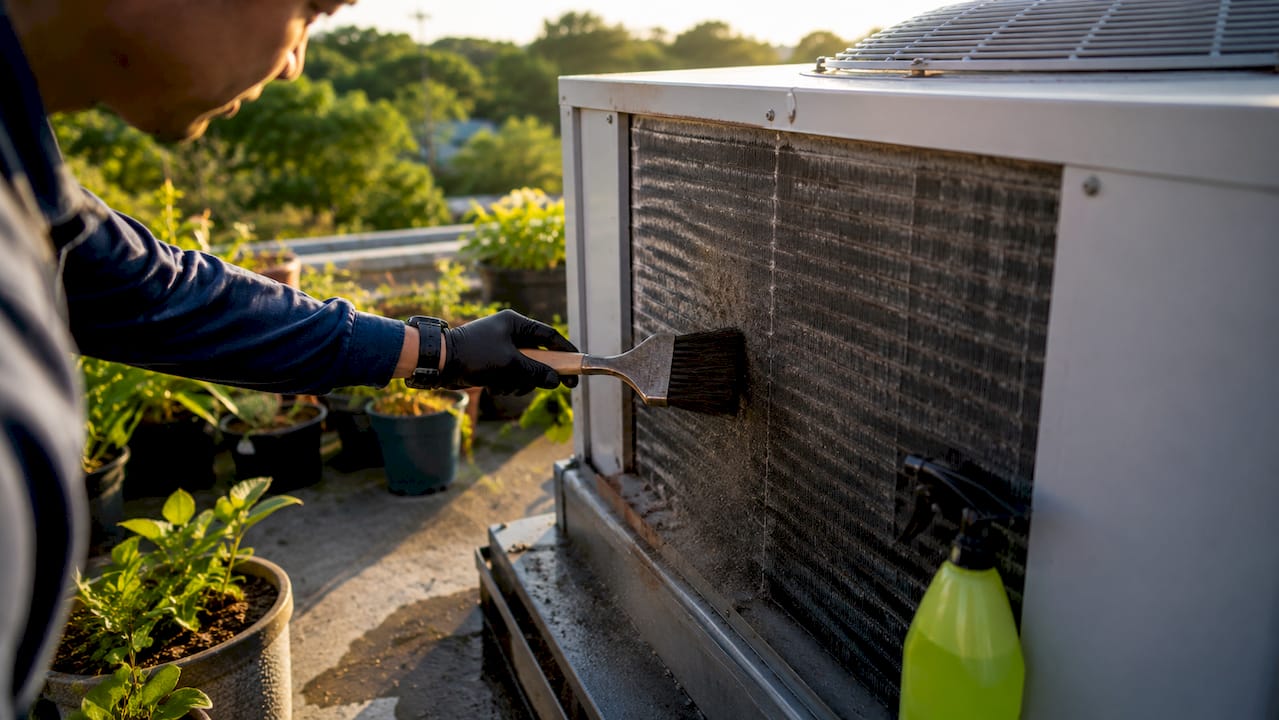
The most common targets are rooftop HVAC units, exhaust fans, condenser coils, and surface membranes. Each requires a different approach. HVAC coils need gentle rinsing to preserve fin integrity. Exhaust fans require degreasing and blade scraping. Surface membranes respond well to soft washing techniques that avoid the granule damage caused by high pressure. The goal across all of these is the same: restore function, prevent damage, and extend service life.
What are the main rooftop cleaning methods?
The four primary rooftop cleaning methods are soft washing, pressure washing, chemical-only application, and mechanical cleaning. Each carries distinct pressure levels, chemical requirements, and risk profiles.
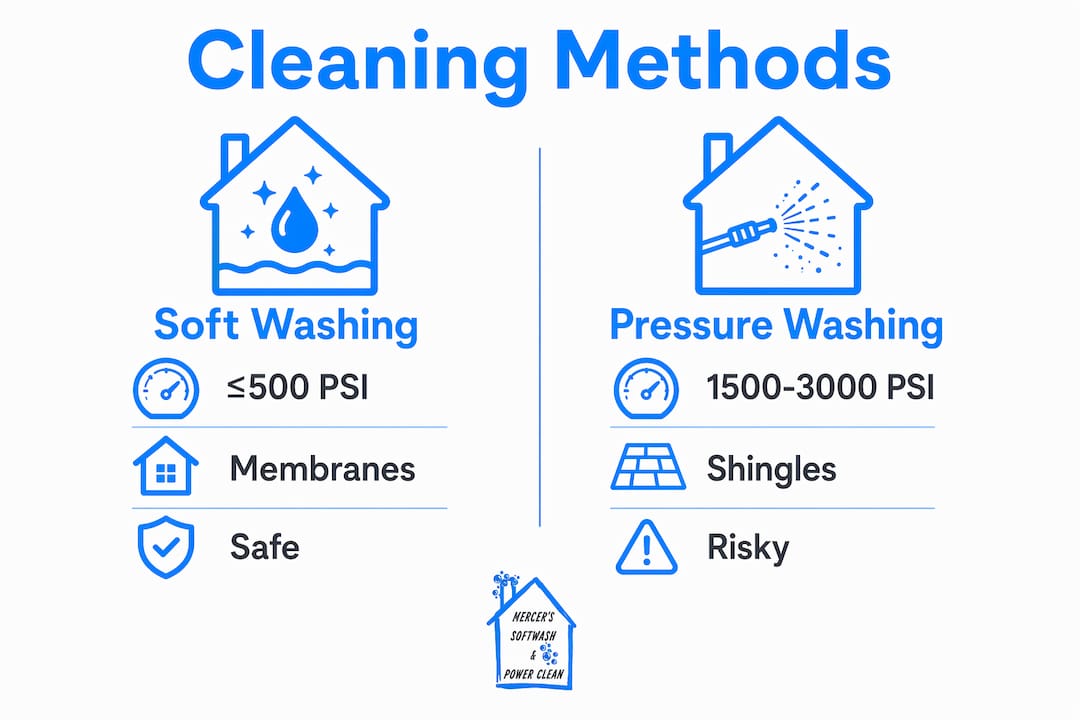
Soft washing uses pressure at or below 500 PSI combined with a chemical solution, typically sodium hypochlorite, to kill and lift biological growth without physical abrasion. This is the industry standard for rooftop surfaces and HVAC exteriors because it preserves surface integrity while delivering thorough decontamination.
Pressure washing operates at 1,500–3,000 PSI. At those levels, high-pressure cleaning on asphalt shingles strips protective granules and voids manufacturer warranties. Pressure washing has a role in certain industrial rooftop maintenance contexts, such as concrete equipment pads, but it is the wrong tool for most rooftop surfaces.
Chemical-only methods, sometimes called “spray and forget” treatments, apply a diluted solution without any rinsing or mechanical follow-up. These work for light biological maintenance but are insufficient for heavy grease or debris accumulation.
Mechanical cleaning covers physical tasks: scraping fan blades, clearing debris from drain channels, and removing scale from coil surfaces. This method is always paired with chemical treatment for complete results.
| Method | Pressure Level | Best Use | Key Risk |
|---|---|---|---|
| Soft washing | ≤500 PSI | Rooftop membranes, HVAC exteriors | Requires correct chemical dilution |
| Pressure washing | 1,500–3,000 PSI | Concrete pads, industrial surfaces | Granule damage, warranty voids |
| Chemical-only | No pressure | Light biological maintenance | Ineffective on heavy buildup |
| Mechanical cleaning | No pressure | Fan blades, coil surfaces, drains | Fin damage if done incorrectly |
Pro Tip: When comparing soft washing vs pressure washing for rooftop equipment, default to soft washing for any surface with a manufacturer warranty. The pressure difference between the two methods is not minor — it is the difference between cleaning and damaging.
How are chemical solutions applied in rooftop cleaning?
Sodium hypochlorite is the primary active agent in professional rooftop chemical cleaning. The correct concentration ranges from 1.5% to 6% depending on the severity of biological growth. Light algae growth calls for the lower end of that range. Heavy moss, lichen, or mould infestations require concentrations closer to 6%.
Application technique matters as much as concentration. Professionals apply solutions from the top of the surface downward, working in small sections to maintain consistent dwell time and prevent premature runoff. The chemical must remain on the surface for 15–30 minutes to fully penetrate and kill biological contaminants at the root level. Cutting that dwell time short produces surface-level results that return within weeks.
The key principle in soft washing is that the chemical solution does the cleaning, not the water pressure. This is why professional soft washing pumps include proportioner valves that blend sodium hypochlorite with fresh water at precise ratios. After each job, technicians flush those pumps thoroughly to prevent sodium hypochlorite from corroding the internal components.
Environmental protection is part of every chemical application. Technicians wet down surrounding vegetation before applying solution and rinse it again after. Electrical components and wiring near the application zone are covered or avoided entirely.
Pro Tip: Avoid manually rinsing soft wash solutions from rooftop surfaces whenever possible. Rain provides a gentler, more even rinse that prevents water from being forced under flashing or into seams. Aggressive manual rinsing is one of the most common causes of water ingress after a cleaning job.
Why does cleaning HVAC units and exhaust fans matter?
Cleaning HVAC units is not a cosmetic task. Dirty condenser coils force the system to work harder to achieve the same output, and coil cleaning reduces cooling energy consumption by up to 20% by restoring airflow and reducing run times. That is a measurable return on a maintenance investment that most facility budgets can justify quickly.
The procedure for cleaning HVAC coils follows a specific sequence:
- Power off the unit completely before any water or chemical contact
- Remove debris from the cabinet and surrounding area
- Apply a coil-safe cleaning solution and allow it to dwell
- Rinse from the inside out, pushing dirt away from the fins rather than deeper into them
- Inspect fins for bending and straighten with a fin comb if needed
- Restore power only after the unit is fully dry
Professional HVAC maintenance typically costs $80–$250 per visit and prevents 80% of common operational issues. Annual maintenance budgets generally run $150–$500 per unit. That cost is a fraction of an emergency compressor replacement or a full system failure during peak summer demand.
Rooftop exhaust fan cleaning is the most overlooked part of commercial kitchen and industrial rooftop maintenance. Grease accumulates on fan blades, inside the housing, and along the ductwork above the roofline. Left untreated, that grease is a direct fire hazard.
“Facility managers should not overlook rooftop exhaust fan cleaning since grease buildup creates dangerous fire hazards if left untreated.” — National Hood Cleaning Industry Guidance
NFPA 96 requires that rooftop exhaust fans be equipped with fan hinge kits that allow the unit to tip safely to one side without disconnecting or stressing the electrical wiring. This hinged access allows technicians to scrape and degrease the interior of the fan housing, the blades, and the curb below. Without a hinge kit, technicians either skip the interior cleaning entirely or risk damaging the wiring by forcing the unit open. Both outcomes are unacceptable from a safety and compliance standpoint.
What safety practices should property managers follow?
Industrial rooftop maintenance requires a structured approach to safety before, during, and after every cleaning session. The most common and costly mistakes come from skipping the preparation steps.
Before any cleaning begins, document the roof condition with photographs. Note existing cracks, membrane damage, pooling areas, and the condition of flashing around equipment bases. This record protects you if a dispute arises about pre-existing damage, and it gives the cleaning crew a clear picture of what to work around.
During chemical application, protect all electrical wiring and conduit runs near the work area. When tipping exhaust fans using a hinge kit, confirm the wiring has enough slack to accommodate the movement before applying any force. Forcing a fan open without checking wire length is how electrical shorts happen.
After cleaning, flush all chemical pumps with fresh water. Sodium hypochlorite left in pump lines corrodes seals and valves, shortening equipment life significantly. This step takes less than five minutes and extends pump life by years.
One of the most persistent problems in commercial rooftop cleaning is what industry professionals call “hood shining.” This is the practice of wiping down the visible exterior surfaces of exhaust hoods and fans without cleaning the interior, blades, or ductwork. It looks clean from the ground but leaves the fire hazard completely intact. Any maintenance contract should specify interior fan and duct cleaning explicitly, not just exterior surface cleaning.
Pro Tip: Integrate rooftop equipment cleaning into your annual facility maintenance budget as a fixed line item rather than a reactive expense. Regular cleaning prevents high-cost repairs and equipment failure, and it is far easier to justify a predictable annual cost than an emergency service call during a heat wave or a fire inspection.
Key takeaways
Effective rooftop equipment cleaning relies on matching the right chemical concentration and method to each surface type, with soft washing and NFPA 96-compliant fan procedures forming the foundation of safe, code-compliant maintenance.
| Point | Details |
|---|---|
| Soft washing is the standard | Use pressure at or below 500 PSI with sodium hypochlorite for rooftop surfaces and HVAC exteriors. |
| Chemical concentration drives results | Apply sodium hypochlorite at 1.5%–6% with a 15–30 minute dwell time for full biological elimination. |
| HVAC coil cleaning saves energy | Clean coils reduce cooling energy consumption by up to 20%, delivering measurable cost savings. |
| Fan hinge kits are required by NFPA 96 | Hinged exhaust fans allow safe interior degreasing without risking electrical damage or wiring shorts. |
| Document before every clean | Photograph roof conditions before each service to protect against liability and track deterioration. |
What i’ve learned after years of rooftop cleaning jobs
The single biggest misconception I encounter from facility managers is that more pressure equals a better clean. It does not. The chemistry does the work. Pressure is just the delivery vehicle, and on most rooftop surfaces, less of it produces better results with fewer consequences.
What I have seen repeatedly is that buildings with well-maintained HVAC units and clean exhaust fans simply run better. Tenants complain less about temperature inconsistency. Kitchen staff report fewer grease odour problems. And when a fire inspector walks through, there are no surprises. The benefits of professional roof cleaning extend well beyond appearance.
The NFPA 96 fan hinge kit requirement is one of the most ignored standards I see in the field. Facilities that skip it are not just out of compliance. They are leaving grease inside a fan housing that sits directly above a heat source, and that is a fire waiting for the right conditions. No cleaning contract is worth signing if it does not address interior fan cleaning with proper hinge access.
My honest recommendation: treat rooftop cleaning as infrastructure maintenance, not cosmetic upkeep. The cost of doing it right is predictable. The cost of not doing it is not.
— Felix
Professional rooftop cleaning services from Mercerssoftwashpowerclean
Mercerssoftwashpowerclean provides commercial and residential exterior cleaning across Southern Ontario, with specialised expertise in soft washing methods that protect rooftop surfaces and HVAC equipment from pressure damage. The team applies sodium hypochlorite at precise concentrations, follows correct dwell times, and handles chemical pump flushing and environmental protection as standard practice on every job. For property managers looking to build rooftop equipment cleaning into a structured maintenance programme, Mercerssoftwashpowerclean offers the technical knowledge and equipment to do it properly. Explore the full range of commercial cleaning services or get in touch to discuss a maintenance plan for your facility.
FAQ
What is soft washing in rooftop equipment cleaning?
Soft washing is a low-pressure cleaning method using pressure at or below 500 PSI combined with sodium hypochlorite solution to kill biological growth without damaging rooftop surfaces or voiding warranties.
How often should rooftop HVAC units be cleaned?
Most commercial rooftop HVAC units benefit from professional maintenance at least once per year, with annual budgets typically ranging from $150–$500 per unit to prevent 80% of common operational issues.
What does NFPA 96 require for exhaust fan cleaning?
NFPA 96 requires fan hinge kits on rooftop exhaust fans so technicians can safely tip the unit for interior degreasing without damaging electrical wiring or leaving grease buildup that creates fire hazards.
Can pressure washing damage rooftop equipment?
High-pressure washing at 1,500–3,000 PSI strips protective granules from asphalt shingles and can void manufacturer warranties, making it unsuitable for most rooftop surfaces and equipment exteriors.
How long should a chemical solution dwell on a rooftop surface?
Sodium hypochlorite solutions require a dwell time of 15–30 minutes to fully penetrate and eliminate biological contaminants such as algae, moss, and mould at the root level.


