

An exterior building cleaning schedule is a tailored plan that specifies the timing and methods for cleaning each surface on your property to preserve its condition, safety, and curb appeal. For homeowners and property managers across Southern Ontario, this kind of structured approach is not optional. Freeze-thaw cycles, road salt spray, heavy pollen seasons, and humid summers create conditions that accelerate biological growth, staining, and surface deterioration faster than in many other Canadian regions. This exterior building cleaning schedule guide covers how to assess your property, set realistic frequencies, choose the right methods, and build a plan that actually holds up through the seasons.
How to assess your property’s exterior cleaning needs
Exterior cleaning frequency should be determined by building use, location, materials, and exposure, not just appearance. That principle is the foundation of every effective cleaning schedule. Before you set any dates or book any services, you need to walk your property and take stock of what you are actually dealing with.
Start with a surface inventory. Walk the full perimeter of your building and note every exterior element: siding, brick, stucco, concrete walkways, asphalt, wood decking, windows, gutters, and roofing. Each material has a different vulnerability. Brick is porous and absorbs moisture, making it prone to efflorescence and moss. Vinyl siding collects algae and mildew in shaded areas. Asphalt and concrete surfaces near driveways accumulate oil, road salt residue, and organic debris.

Next, assess your exposure factors. A property on a busy road in Oshawa faces more particulate pollution than a rural property in Northumberland County. A north-facing wall that stays shaded most of the day will develop algae and lichen faster than a south-facing one. High foot traffic entrances collect grime and slip-risk contaminants at a much higher rate than a quiet side wall.
Risk-led scheduling means assigning failure modes to each surface, such as water intrusion risk, algae slip risk, or stain set-in risk, and using those failure modes to set your cleaning intervals. This approach produces a more precise and cost-effective schedule than simply cleaning everything on a fixed annual cycle.
Pro Tip: Take photos during your walkthrough and date them. Comparing photos year over year reveals how quickly specific surfaces are deteriorating, which helps you justify adjusting your cleaning frequency before visible damage sets in.
What cleaning frequency does each surface need?
Typical commercial exterior cleaning intervals include façade cleaning every 12–24 months, entrances and walkways every 3–6 months, car parks every 6–12 months, and windows monthly or quarterly. Residential properties generally follow a similar logic, though the intervals can be stretched slightly depending on exposure and use.
The table below summarises recommended cleaning frequencies for common exterior surfaces and areas in Southern Ontario:
| Surface or Area | Recommended Frequency | Notes |
|---|---|---|
| Building façade (siding, brick, stucco) | Every 12–24 months | Adjust for shaded or high-pollution exposure |
| Windows and glazing | Monthly to quarterly | Higher frequency during spring pollen season |
| Entrances and walkways | Every 3–6 months | Prioritise slip risk in autumn and winter |
| Gutters and downspouts | Twice yearly minimum | After leaf fall and after spring thaw |
| Roof (shingles, flat membrane) | Every 1–3 years | Depends on moss, lichen, or algae presence |
| Driveways and car parks | Every 6–12 months | Salt and oil staining accelerates deterioration |
| Decks and fences | Annually | Wood surfaces need pre-season preparation |
Windows and high-visibility entrances often require separate, more frequent cleaning intervals than façades to maintain curb appeal. This is a detail many property owners overlook. A freshly washed building façade loses its impression quickly if the windows are streaked and the front entrance is grimy.
Seasonal cleanings such as a spring deep clean and fall gutter clearing are non-negotiable for Southern Ontario properties. Spring cleaning removes the salt residue, sand, and biological growth that accumulate over winter. Fall preparation clears leaf debris from gutters and drains before freeze-thaw cycles trap moisture against your building envelope.
For commercial properties, the stakes are higher. A retail entrance with a slip-risk walkway or a stained façade affects customer perception and can create liability exposure. Seasonal exterior cleaning for homeowners follows the same logic at a smaller scale.
Which cleaning method is right for each surface?
Matching cleaning method to surface type increases cleaning effectiveness and protects building materials. The four primary methods used in exterior building maintenance are pressure washing, soft washing, chemical cleaning, and manual scrubbing. Each has a specific application.
-
Pressure washing uses high-pressure water to remove heavy deposits from hard surfaces like concrete, brick, and asphalt. It is effective for driveways, walkways, and interlock but can damage softer materials like vinyl siding, wood, or aged mortar if applied incorrectly.
-
Soft washing uses low-pressure water combined with cleaning solutions, typically Sodium Hypochlorite and surfactants, to kill and remove biological growth such as algae, mould, and lichen. It is the correct method for roofs, siding, stucco, and painted surfaces. You can read more about how soft washing works before deciding which approach suits your property.
-
Chemical cleaning targets specific staining types. Efflorescence on brick responds to diluted acid wash. Rust staining on concrete requires an oxalic acid-based treatment. Using the wrong chemical on the wrong surface causes oxidation, discolouration, or surface etching.
-
Manual scrubbing is reserved for small areas, delicate surfaces, or spot treatments where mechanical or chemical methods carry too much risk.
Using wrong cleaning methods can damage finishes or cause water intrusion that accelerates deterioration and biological growth. Water forced behind siding or into cracked mortar joints creates the exact conditions that make future cleaning harder and repairs more expensive.
Pro Tip: Test cleaning methods on a small, inconspicuous area before committing to a full surface treatment. A 30-by-30-centimetre test patch reveals how a surface responds to pressure, chemicals, or heat before any damage becomes irreversible.
How to build an effective exterior cleaning schedule
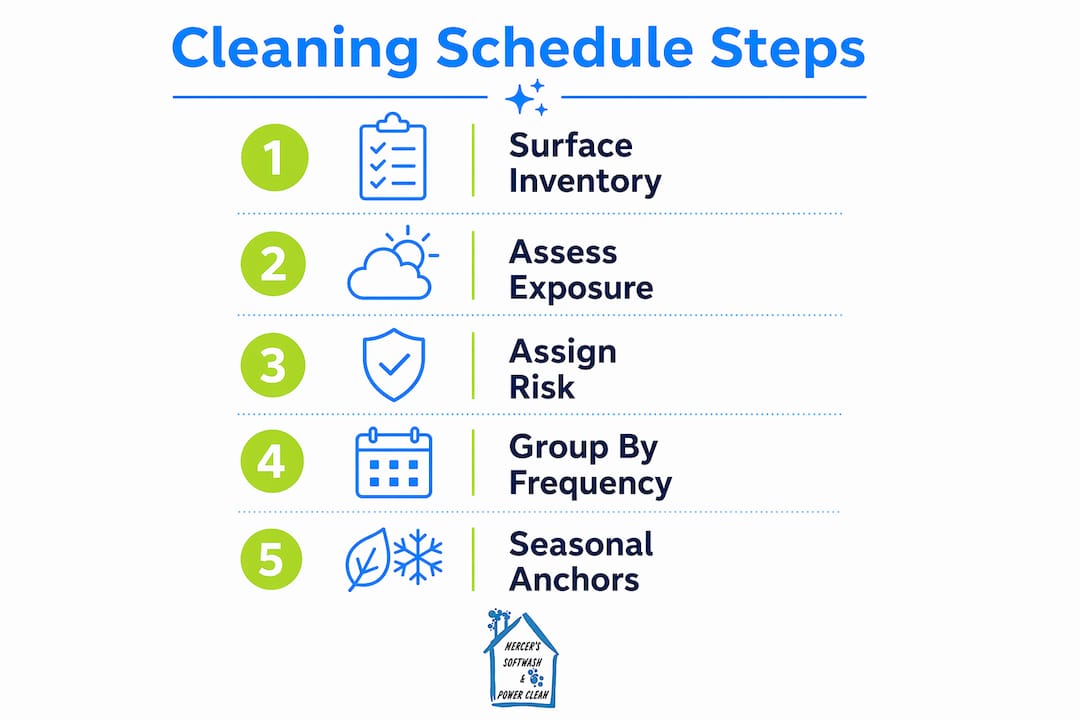
A property walkthrough inventory is the starting point for any practical cleaning schedule. Once you have your surface list and risk assessment in hand, building the actual schedule follows a clear process.
Step 1: Group tasks by frequency. Separate your cleaning tasks into four categories: monthly (windows, high-traffic entrances), quarterly (walkways, visible glazing), semi-annual (gutters, driveways), and annual or biannual (façades, roofs, decks). This grouping prevents the common mistake of treating every surface as if it needs the same attention at the same time.
Step 2: Anchor tasks to seasonal windows. In Southern Ontario, the two most productive cleaning windows are late april to may and late august to september. Spring cleaning addresses winter damage and prepares surfaces for the humid summer months. Late summer cleaning removes biological growth before it sets in over winter. Avoid scheduling façade washing in november or december when temperatures drop below 5°C, as cleaning solutions lose effectiveness and surfaces can freeze before drying.
Step 3: Assign risk ratings to each task. Label each item on your checklist as high, medium, or low priority based on the failure mode you identified during your walkthrough. A gutter blocked with leaf debris in october is a high-priority item because it creates immediate water intrusion risk. A lightly soiled fence panel is low priority and can wait for the next annual cycle.
Step 4: Build your master checklist. Create a single document that lists every surface, its cleaning method, its frequency, and its last service date. Update it after every cleaning. This record becomes valuable when you are assessing whether a surface is deteriorating faster than expected or when you are handing off maintenance responsibilities to a new property manager.
Step 5: Review and adjust annually. Viewing exterior cleaning as an asset protection measure rather than cosmetic maintenance changes how you approach the annual review. Ask whether any surfaces showed unexpected deterioration, whether any cleaning intervals proved too frequent or too infrequent, and whether any new exposure factors have emerged.
Pro Tip: Sidewalk pressure washing one or two times per year is sufficient for most residential properties, but if your property is near a road treated with road salt, increase that to three times annually to prevent salt-driven concrete spalling.
How do you handle common scheduling challenges?
Every exterior maintenance plan runs into obstacles. Weather delays, budget constraints, and access issues are the three most common disruptions, and each has a practical solution.
Weather delays are unavoidable in Southern Ontario. A planned spring cleaning can be pushed back by a wet april or a late frost. Build a two-week buffer into every scheduled cleaning window. If a cleaning is delayed beyond four weeks, reassess whether the delay has created any new risk, particularly for gutters and flat roof drains where standing water causes rapid damage.
Budget constraints force prioritisation. When you cannot clean everything on schedule, use your risk ratings to decide what gets done first. High-risk items like blocked gutters, slip-risk walkways, and water-stained soffits take precedence over lower-risk cosmetic tasks like fence washing or driveway cleaning. Regular exterior cleaning prevents structural damage and maintains property value, so deferring high-risk tasks to save money in the short term typically costs more in repairs later.
Access issues affect multi-storey buildings, properties with dense landscaping, or commercial sites with restricted operating hours. For upper-level surfaces, factor in the cost and logistics of lift equipment or rope access when setting your cleaning budget. Scheduling these tasks during low-traffic periods reduces disruption and safety risk.
Signs that your current schedule needs adjustment include recurring biological growth within six months of cleaning, persistent staining that does not respond to your standard method, and surfaces that show physical deterioration between cleaning cycles. These are signals that either your frequency is too low or your cleaning method is not addressing the root contamination. Reviewing your exterior cleaning compliance practices annually keeps your approach current with both property conditions and best practices.
Key takeaways
A risk-led exterior building cleaning schedule, anchored to surface type, seasonal timing, and failure mode, is the most effective way to protect property value and appearance in Southern Ontario.
| Point | Details |
|---|---|
| Risk-led assessment first | Walk your property and assign failure modes before setting any cleaning intervals. |
| Surface-specific frequencies | Façades need cleaning every 12–24 months; gutters and entrances need attention every 3–6 months. |
| Match method to material | Soft washing suits siding and roofs; pressure washing suits concrete and interlock. |
| Anchor to seasonal windows | Late spring and late summer are the most effective cleaning windows in Southern Ontario. |
| Review and adjust annually | Update your master checklist each year based on how surfaces responded to the previous cycle. |
What i have learned after years of exterior cleaning in southern ontario
After working on hundreds of properties across the region, the single biggest mistake I see is treating exterior cleaning as a reactive task. A homeowner notices green algae creeping up the north wall in july and calls for a wash. The problem is that algae visible to the naked eye has already been growing for months. By the time it is obvious, it has likely penetrated the surface and will return faster after cleaning than it would have if it had been addressed earlier in its growth cycle.
The second pattern I see consistently is over-cleaning hard surfaces and under-cleaning biological ones. Homeowners pressure wash their driveways every spring because the results are immediately visible and satisfying. Meanwhile, the roof accumulates lichen for three years because it is out of sight. Lichen physically damages shingles by lifting granules and holding moisture against the surface. The benefits of professional roof cleaning go well beyond appearance. Addressing it on a proper schedule extends roof life measurably.
My honest recommendation is to build your schedule around what your property actually needs, not what is most convenient or most visible. A north-facing brick wall in a shaded yard needs more attention than a sunny vinyl-sided south wall. A commercial property with heavy foot traffic needs quarterly entrance cleaning regardless of how clean it looks after a dry summer. Let the risk drive the schedule, and the results will speak for themselves.
— Felix
Let Mercerssoftwashpowerclean handle your cleaning schedule
Putting together a cleaning schedule is one thing. Executing it correctly, with the right equipment and the right chemistry for each surface, is another. Mercerssoftwashpowerclean serves homeowners and property managers across Southern Ontario with professional soft washing, pressure washing, roof cleaning, gutter cleaning, window cleaning, and more. Whether you need a one-time spring deep clean or a recurring maintenance programme for a commercial property, the team brings the expertise to protect your investment properly. Start by exploring residential cleaning services or learn more about soft washing for house siding to understand which approach fits your property best.
FAQ
What is an exterior building cleaning schedule?
An exterior building cleaning schedule is a structured plan that outlines which surfaces need cleaning, how often, and by which method. It is designed to protect property condition, safety, and appearance over the long term.
How often should i clean my building’s exterior in southern ontario?
Façades typically need cleaning every 12–24 months, gutters twice yearly, and entrances every 3–6 months. Southern Ontario’s freeze-thaw cycles and humid summers mean biological growth and salt residue accumulate faster than in drier climates.
What is the difference between soft washing and pressure washing?
Soft washing uses low pressure and cleaning solutions like Sodium Hypochlorite to kill biological growth on surfaces like roofs and siding. Pressure washing uses high-pressure water to remove heavy deposits from hard surfaces like concrete and interlock.
When is the best time of year to clean a building exterior in ontario?
Late spring (april to may) and late summer (august to september) are the most effective windows. Spring removes winter grime and salt residue; late summer addresses biological growth before it sets in over the colder months.
How do i know if my cleaning schedule needs to be adjusted?
Recurring biological growth within six months of cleaning, persistent staining, or visible surface deterioration between cycles are clear signs that your frequency or method needs to change. An annual review of your maintenance checklist helps catch these patterns early.


