

Commercial pressure washing is defined as the use of high-pressure water systems, and in some cases low-pressure soft washing methods, to remove contaminants from exterior building surfaces at a commercial scale. For facility managers and property owners across Southern Ontario, it is one of the most cost-effective maintenance tools available. The benefits of commercial pressure washing extend well beyond appearance. They include reduced liability exposure, longer surface lifespan, and stronger tenant retention. Mercerssoftwashpowerclean works with commercial clients who want to protect their investment and maintain properties that reflect well on their business.
1. How does commercial pressure washing improve curb appeal and professional image?
A clean exterior is the first signal a property sends to tenants, customers, and visitors. Grime, mould, algae staining, and graffiti accumulate gradually, and property owners often underestimate how much they affect perception. Consistent pressure washing schedules improve tenant retention and lease rates, as clean properties fill vacancies faster and hold tenants longer. That is a direct financial return on a maintenance service.
Removing surface contaminants revitalises concrete, brick, cladding, and signage without the cost of replacement or repainting. A parking lot stripped of oil stains and tyre marks looks newer and signals active management. The same applies to building facades where oxidation, mildew, and biological growth create a neglected appearance even on structurally sound surfaces.
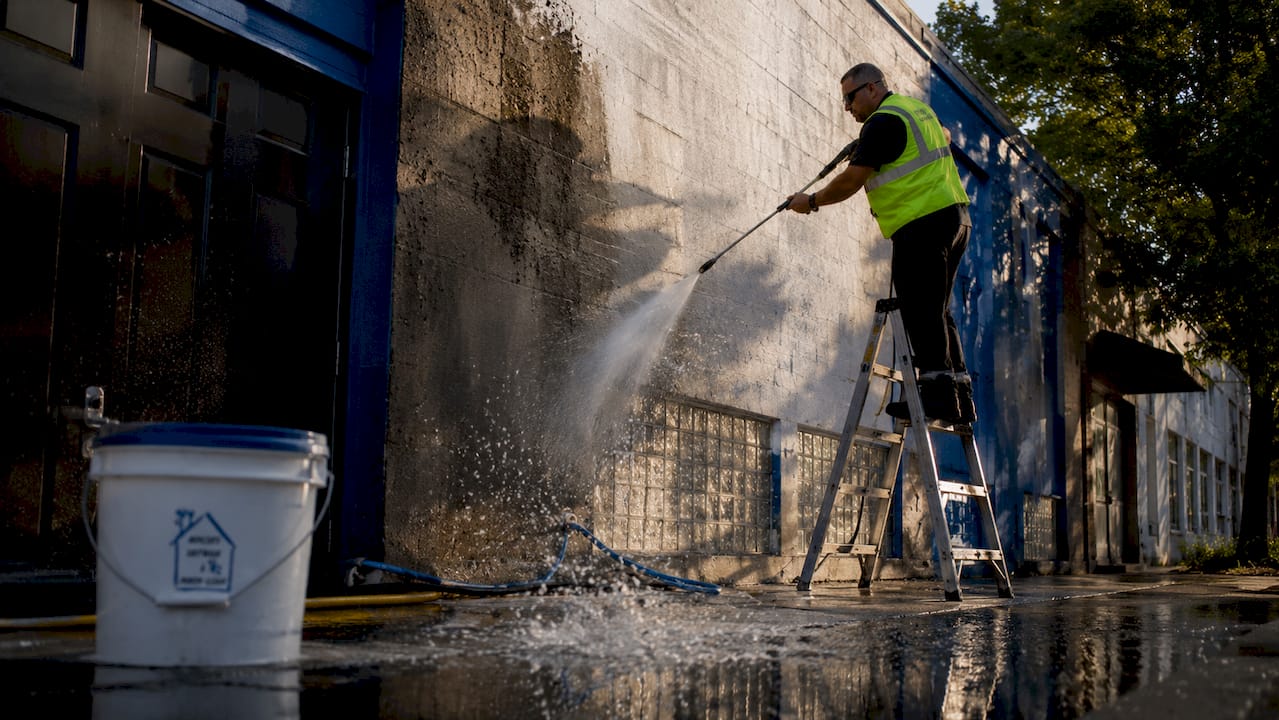
Professional image is also reinforced through documented maintenance. When tenants or customers see that cleaning is scheduled and consistent, it builds confidence in how the property is managed overall.
Pro Tip: Schedule exterior cleaning before lease renewals or property inspections. A freshly cleaned facade and parking area can meaningfully influence a tenant’s decision to stay.
2. What are the health and safety advantages for commercial properties?
Slip-and-fall accidents are one of the most common and costly liability risks on commercial properties. OSHA reports identify slips, trips, and falls as responsible for 15% of workplace deaths. Algae, grease, and oil on walkways, loading docks, and parking surfaces create exactly the conditions that lead to these incidents.
Pressure washing removes those hazards at the source. Walkways, dumpster pads, and drive-through surfaces cleaned on a regular schedule stay free of the biological and chemical buildup that makes surfaces slippery. Routine exterior sanitation also mitigates pest odours and allergen accumulation, which supports compliance with municipal health codes.
“Proactive exterior maintenance reduces liability before an incident occurs. Reactive cleaning after a slip-and-fall is always more expensive than the cleaning that would have prevented it.”
Sanitising dumpster enclosures and grease trap areas also reduces the conditions that attract pests. For food service properties, retail centres, and multi-tenant buildings, this is a code compliance issue as much as a cleanliness one. Keeping these areas clean protects employees, customers, and the property owner from both health and legal consequences.
3. How does pressure washing prevent costly structural damage?
Surface contaminants do not just look bad. They actively degrade building materials over time. Mould and algae retain moisture against concrete, brick, and wood, accelerating oxidation and freeze-thaw damage. Mineral staining from hard water and rust from metal fixtures etches into porous surfaces if left untreated. Proactive exterior care reduces lifecycle costs by preventing minor issues from escalating to expensive repairs or premature replacements.
IFMA guidelines support exterior maintenance as a core component of building asset management. Facility managers who follow scheduled cleaning programmes see extended material lifespan across concrete, masonry, and cladding. Maintained properties typically show 15–25% longer concrete life and better marketability compared to properties where cleaning is reactive.
The financial logic is straightforward. A professional cleaning visit costs a fraction of concrete resurfacing, facade repainting, or cladding replacement. Catching biological growth and staining early means the surface can be restored rather than replaced.
Pro Tip: Pay particular attention to north-facing walls and shaded areas. These surfaces stay damp longer and develop mould and algae growth faster than sun-exposed areas.
4. What equipment and methods define professional commercial pressure washing?
What is commercial pressure washing at the equipment level? Professional systems operate at 2,500 to 4,000+ PSI, with truck-mounted units capable of sustaining high flow rates across large surface areas. Consumer units cannot match this output for sustained commercial cleaning volumes. The difference matters because underpowered equipment leaves contaminants behind and requires multiple passes, increasing labour time and cost.
Hot water pressure washing emulsifies grease and organic buildup more effectively than cold water. This makes it the correct choice for gas stations, drive-throughs, parking garages, and food service loading areas. Hot water systems use burner units to reach the temperatures needed to break down fats and oils that cold water cannot lift.
Soft washing is a distinct method that operates at 100–500 PSI using biodegradable cleaning solutions to treat delicate surfaces. It is the appropriate method for EIFS cladding, painted wood, and older masonry where high pressure would cause etching or force water behind the surface layer. Understanding when to use each method is what separates professional results from DIY damage.
| Surface type | Recommended method | Pressure range |
|---|---|---|
| Concrete, asphalt, pavers | High-pressure washing | 2,500–4,000 PSI |
| Brick and masonry | High-pressure or soft wash | 1,500–3,000 PSI |
| EIFS, stucco, painted wood | Soft washing | 100–500 PSI |
| Drive-throughs, grease areas | Hot water pressure washing | 2,500–4,000 PSI |
| Signage and glass | Soft washing | 100–300 PSI |
5. Why does chemistry matter as much as pressure?
The Right Chemistry, Right Pressure, Right Technique triad is the professional standard for effective commercial cleaning. Increasing pressure without matching the correct cleaning solution to the surface type causes damage without improving results. Sodium Hypochlorite, for example, is used in soft washing to kill biological growth at the root rather than simply blasting it off the surface. This prevents regrowth and extends the time between cleaning cycles.
Matching chemistry to substrate is particularly important for surfaces like exterior cladding and signage. Acid-based cleaners remove mineral staining and rust from concrete and masonry but will damage painted surfaces or aluminium. Alkaline degreasers work on grease and oil but require neutralisation before runoff enters storm drains. Professional cleaners select and apply the right product for each surface, which is why the results differ so significantly from general-purpose cleaning.
Using appropriate cleaning chemistry is more effective and safer than simply increasing pressure. This principle protects your surfaces and reduces the risk of water intrusion, etching, or chemical damage that would create the very repair costs you are trying to avoid.
6. How should facility managers build a pressure washing maintenance programme?
A maintenance programme built around scheduled cleaning is always more cost-effective than reactive cleaning after visible deterioration. The frequency depends on property type, traffic volume, and surrounding environment. A food service property or high-traffic retail centre needs monthly dumpster pad and entrance cleaning. A low-traffic office building may require quarterly facade and parking cleaning.
Combining pressure washing with sweeping and general exterior sanitation services improves overall efficiency. Clean surfaces stay cleaner longer when debris is removed regularly rather than allowed to accumulate and stain. Industrial exterior cleaning programmes integrate these services into a single scheduled maintenance plan, reducing the coordination burden on facility managers.
Documentation is a practical requirement, not just a best practice. Service records support insurance claims, demonstrate due diligence in slip-and-fall liability situations, and satisfy tenant expectations for maintained common areas. Exterior cleaning compliance in 2026 increasingly requires documented service histories for multi-tenant and commercial properties.
Pro Tip: Keep a simple log of each cleaning visit, including the date, areas cleaned, and methods used. This record costs nothing to maintain and can be valuable if a liability question arises.
Key takeaways
Commercial pressure washing protects property value, reduces liability, and extends surface lifespan when the correct pressure, chemistry, and technique are matched to each surface type.
| Point | Details |
|---|---|
| Curb appeal drives occupancy | Clean exteriors fill vacancies faster and support stronger tenant retention. |
| Safety compliance reduces risk | Removing algae, grease, and oil from walkways directly lowers slip-and-fall liability. |
| Scheduled cleaning prevents damage | Proactive maintenance extends concrete and surface lifespan by 15–25% compared to reactive cleaning. |
| Method selection protects surfaces | High-pressure washing suits hardscapes; soft washing at 100–500 PSI protects delicate cladding and signage. |
| Documentation supports compliance | Service records demonstrate due diligence for insurance, code compliance, and tenant relations. |
Why I think facility managers underestimate pressure washing
Most facility managers I speak with treat exterior cleaning as a cosmetic line item. They cut it when budgets tighten and restore it when a tenant complains. That approach costs more in the long run, and the numbers support it.
The properties that hold their value and attract quality tenants are not necessarily the newest ones. They are the ones that are visibly maintained. A clean parking lot, a stain-free facade, and a graffiti-free entrance communicate active management. That signal matters to tenants deciding whether to renew a lease and to customers deciding whether to walk through the door.
Pressure washing is also one of the few maintenance services where the cost-to-benefit ratio is genuinely clear. You can see the before and after. You can document it. And you can point to it directly when a tenant asks what you have done to maintain the property. That kind of tangible, visible maintenance builds the trust that keeps occupancy rates stable.
The one mistake I see most often is using the wrong method on the wrong surface. High pressure on EIFS or painted wood causes damage that costs far more to repair than the cleaning saved. Working with a professional service that understands the distinction between pressure washing and soft washing is not a luxury. It is the difference between maintenance and liability.
— Felix
Mercerssoftwashpowerclean: commercial exterior cleaning across Southern Ontario
Mercerssoftwashpowerclean provides professional pressure washing and soft washing services tailored specifically for commercial properties across Southern Ontario. The team uses commercial-grade equipment, including hot water systems and truck-mounted units, matched to the surface type and contamination level of each property. Services cover parking areas, building facades, dumpster pads, walkways, signage, and graffiti removal. If you are ready to build a scheduled maintenance programme or need a one-time deep clean, choosing the right method for your property is the first step. Contact Mercerssoftwashpowerclean to schedule a commercial cleaning assessment.
FAQ
What is commercial pressure washing?
Commercial pressure washing is the use of high-pressure water systems, typically operating at 2,500–4,000+ PSI, to clean exterior surfaces on commercial properties including facades, parking areas, walkways, and loading docks.
How often should commercial properties be pressure washed?
Frequency depends on property type and traffic volume. High-traffic retail and food service properties benefit from monthly cleaning of high-contact areas, while lower-traffic office buildings typically require quarterly exterior cleaning.
Is soft washing different from pressure washing for commercial buildings?
Soft washing uses 100–500 PSI combined with biodegradable cleaning solutions and is the correct method for delicate surfaces like EIFS, painted wood, and signage. High-pressure washing is reserved for hardscapes like concrete and asphalt.
Does pressure washing reduce liability for property owners?
Removing algae, grease, and oil from walkways and parking surfaces directly reduces slip-and-fall risks. OSHA identifies slips, trips, and falls as responsible for 15% of workplace deaths, making surface cleaning a measurable liability reduction tool.
How does pressure washing extend the life of building surfaces?
Biological growth and mineral staining retain moisture against surfaces, accelerating oxidation and freeze-thaw damage. Regular cleaning removes these contaminants before they cause permanent deterioration, extending material lifespan by 15–25% compared to reactive maintenance.


