

A recurring pressure wash contract is a formal, ongoing service agreement that commits a contractor to scheduled exterior cleaning visits at defined intervals. Property owners and managers in Southern Ontario use these agreements to maintain curb appeal, protect surfaces from algae and grime buildup, and keep exterior maintenance predictable year-round. When you set up a recurring pressure wash contract correctly, you replace reactive, one-off calls with a structured programme that protects your property’s value and simplifies your maintenance budget. The commercial benefits of pressure washing are well documented, but those benefits only compound when the service is scheduled consistently.
What should you do before setting up a recurring pressure wash contract?
Preparation determines whether a recurring cleaning contract actually fits your property or simply looks good on paper. Before signing anything, you need to align your maintenance obligations with the legal framework governing your property.
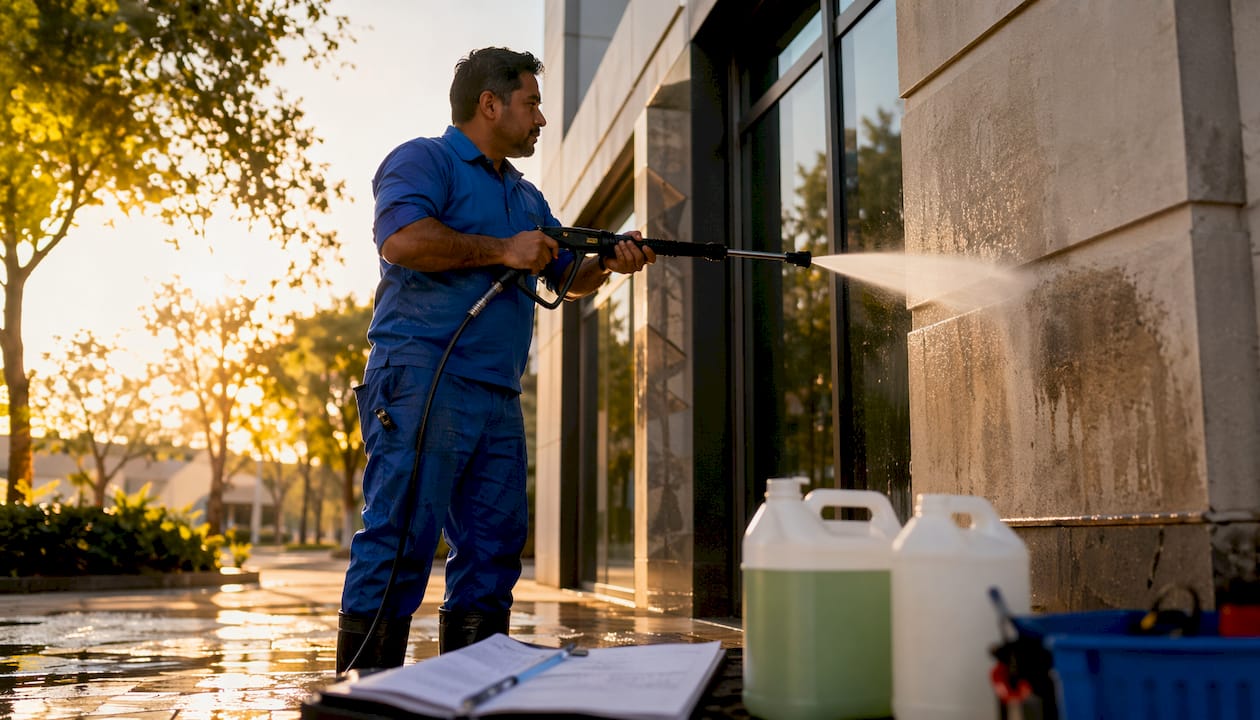
Under Ontario law, commercial maintenance obligations must be explicitly defined in lease agreements to avoid liability confusion. This means you need to review your lease before specifying who is responsible for exterior cleaning. If tenants share responsibility for common areas, that division must appear in both the lease and the service agreement.
A property condition assessment is the next step. Walk every surface you intend to include: walkways, parking areas, building facades, decks, fences, and gutters. Document existing staining, biological growth, and surface damage. This baseline protects you if a contractor later claims damage was pre-existing, and it gives you the detail needed to write a precise scope of work. Generic contract templates often fail to address specific property needs like occupancy, risk, and environment. A tailored scope is not optional; it is the foundation of a contract that actually delivers results.
You also need to confirm that your chosen contractor holds valid liability insurance and complies with Ontario’s environmental regulations around water runoff and cleaning chemical disposal. Sodium Hypochlorite, commonly used in soft washing, requires proper containment and disposal procedures. Confirm these details before the contract is drafted.
- Review your lease for maintenance responsibility clauses before drafting any scope of work.
- Conduct a written property condition assessment with photos before the first visit.
- Confirm contractor insurance, certifications, and environmental compliance.
- Identify tenant responsibilities and coordinate with occupants on access and scheduling.
- Check that your building’s exterior surfaces are compatible with the proposed cleaning method, whether soft washing or high-pressure washing.
Pro Tip: Request a copy of the contractor’s Certificate of Insurance naming your property as an additional insured. This protects you directly if a claim arises from a cleaning visit.
What clauses must a pressure washing service agreement include?
A pressure washing service agreement is only as strong as its written terms. Vague language creates disputes; specific, measurable clauses prevent them.
Service frequency and task descriptions
Define exactly how many visits occur per year and what each visit covers. A quarterly schedule for a commercial property in Southern Ontario typically includes building facade washing, walkway and interlock cleaning, and parking area treatment. Specify the cleaning method for each surface. Soft washing uses low pressure combined with biodegradable cleaning solutions to remove algae and oxidation without damaging siding or roofing materials. High-pressure washing suits concrete, brick, and interlock. Your contract should state which method applies to which surface. Recurring contracts should explicitly address scheduling, specific cleaning methods, and detailed scope relevant to each property type.
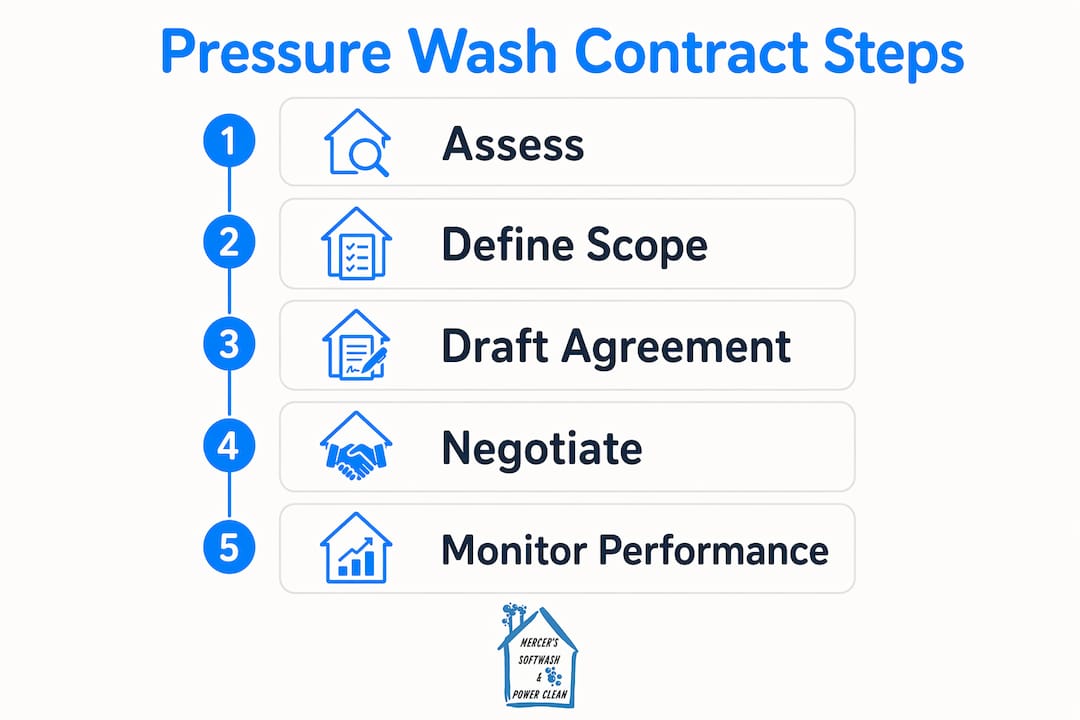
Service level agreements and response times
A service level agreement (SLA) transforms subjective quality assessments into trackable, verifiable metrics by defining response times and escalation procedures. Your SLA should specify the maximum number of days between booking and service delivery, the process for re-cleaning if a visit does not meet the agreed standard, and who to contact if an issue arises. Proper SLAs reduce service complaints by 68% and improve maintenance outcomes through clear, measurable standards. That reduction is significant because it directly lowers the time you spend managing contractor disputes.
Documentation and financial terms
Require written service reports with photos delivered within 24–48 hours of each visit. Timely photo documentation is critical evidence for validating work done and managing insurance or warranty claims. Without it, you have no record of what was cleaned, when, or to what standard.
Financial terms must be explicit. State the base price per visit, the invoicing schedule, and any penalties for missed or substandard visits. Disclose all surcharges upfront. Trucking charges of $50–$150 per visit and fuel surcharges regularly add hidden costs to maintenance contracts. On a quarterly contract, those add-ons can total $380–$660 annually. Require the contractor to itemise every charge before you sign.
- Define service frequency, visit scope, and cleaning method for each surface.
- Include an SLA with response times, re-clean procedures, and escalation contacts.
- Require written service reports with photos within 24–48 hours of each visit.
- State base pricing, invoicing schedule, and all surcharges in writing.
- Add financial penalties for missed visits and incentives for consistent performance.
- Include an exclusion clause listing surfaces or conditions outside the contract scope.
- Add a priority emergency response clause for urgent cleaning needs.
| Clause | What to specify |
|---|---|
| Service frequency | Number of visits per year and seasonal timing |
| Cleaning method | Soft wash or pressure wash per surface type |
| SLA response time | Maximum days from booking to service delivery |
| Documentation | Photo reports within 24–48 hours of each visit |
| Financial terms | Base price, surcharges, penalties, and incentives |
Pro Tip: Add a clause requiring the contractor to notify you at least 72 hours before a scheduled visit. This gives you time to coordinate tenant access and avoid disruptions.
How do you negotiate and finalise a recurring pressure wash contract?
Negotiation is where you convert a standard template into an agreement that reflects your property’s actual needs. Start by requesting the contractor’s standard contract, then revise it rather than accepting it as-is.
The exterior building cleaning schedule for Ontario properties should account for seasonal conditions. Spring visits address winter salt residue and biological growth that accelerates in warmer months. A late-summer or early-autumn visit removes algae before it sets into porous surfaces over winter. Build these seasonal realities into your visit schedule rather than accepting a generic quarterly split.
Negotiate price escalation terms explicitly. A contract with no escalation clause exposes you to sudden rate increases at renewal. A fixed annual escalation cap of a stated percentage is fairer to both parties and easier to budget for. Also negotiate a priority response clause. Priority emergency response clauses ensure maintenance clients receive faster dispatch and reduce downtime risks during peak seasons. For a commercial property with high foot traffic, a graffiti incident or a slip-hazard on a walkway requires same-day or next-day response. That commitment must be written into the contract.
- Request the contractor’s standard agreement and mark up every vague term before counter-signing.
- Specify soft washing versus pressure washing for each surface to prevent surface damage.
- Cap annual price escalations at a fixed percentage agreed by both parties.
- Negotiate a priority emergency response time, stated in hours, not days.
- Verify the contractor’s certifications, insurance coverage, and at least two references from comparable properties.
Pro Tip: Ask for references from property managers with similar building types in Southern Ontario. A contractor experienced with commercial interlock and building facades will produce better results than one whose portfolio is primarily residential driveways.
What mistakes should you avoid in a recurring pressure washing contract?
The most common contract failures share one trait: vague language that leaves room for interpretation. Contracts using terms like “as needed” without specific frequencies are service call arrangements disguised as maintenance contracts. They provide no preventive care and no accountability.
- Never accept undefined frequency schedules. “As needed” or “periodically” are not service commitments.
- Never waive the documentation requirement. A visit without a written report and photos did not happen, legally speaking.
- Never omit a priority emergency response clause. Without it, urgent cleaning needs go to the back of the queue.
- Never sign a contract that does not disclose all surcharges. Hidden truck and fuel charges add hundreds of dollars annually.
- Never fail to align the contract’s SLA with your tenant lease obligations. A gap between the two creates liability.
Contracts without documented service level agreements cost commercial businesses an average of $12,400 annually in dispute-related costs. That figure reflects the real price of vague terms, not just inconvenience.
How do you verify ongoing performance under a pressure washing contract?
Signing the contract is the beginning, not the end. Ongoing verification is what keeps a recurring cleaning contract performing at the level you paid for.
- Review every service report within 48 hours of receipt. Compare the photos against your baseline property assessment.
- Track SLA compliance in a simple log. Record the date of each visit, the surfaces cleaned, and any deficiencies noted.
- Schedule a property walkthrough within one week of each visit. Your own eyes catch what reports miss.
- Collect feedback from tenants or building occupants after each visit. They notice issues at ground level that you may not see from an office.
- Review the full contract annually. Adjust the scope, frequency, or pricing terms to reflect changes in occupancy, surface condition, or seasonal patterns.
| Review activity | Frequency |
|---|---|
| Service report review | Within 48 hours of each visit |
| SLA compliance log update | After every visit |
| Property walkthrough | Within one week of each visit |
| Tenant feedback collection | After each visit |
| Full contract review | Annually at renewal |
Adjusting the scope around tenant turnover periods is one of the most overlooked aspects of contract management. A vacancy between tenants is the ideal time to schedule a deep clean of facades, walkways, and common areas. Build that flexibility into the contract from the start.
Key takeaways
A recurring pressure wash contract delivers consistent exterior maintenance only when it contains specific frequencies, measurable SLAs, full cost disclosure, and documented performance records.
| Point | Details |
|---|---|
| Legal alignment | Review Ontario lease terms before drafting any maintenance scope. |
| SLA inclusion | Define response times and re-clean procedures to reduce complaints and disputes. |
| Full cost disclosure | Require upfront itemisation of all surcharges to avoid unexpected annual costs. |
| Photo documentation | Mandate written reports with photos within 24–48 hours of every visit. |
| Ongoing verification | Log SLA compliance and conduct property walkthroughs after each cleaning visit. |
What I’ve learned from years of recurring contract disputes
The contracts that cause the most grief are not the ones with bad contractors. They are the ones with good contractors and bad paperwork. I have seen property managers in Southern Ontario lose thousands of dollars not because the cleaning was poor, but because the contract gave them no mechanism to prove it.
The single change that makes the biggest difference is requiring photo documentation before and after every visit. It sounds basic, but most property owners skip it. Once you have that visual record, every SLA conversation becomes a factual one rather than a subjective argument. The seasonal exterior cleaning schedule also matters more than most owners realise. A contract that ignores Ontario’s freeze-thaw cycle will miss the spring window when biological growth is easiest to remove, and you will pay more for remediation later.
My honest advice: spend more time on the contract than on the quote. A lower price with vague terms will cost you more than a fair price with a tight agreement. Transparency from your service provider is non-negotiable. If a contractor resists putting response times, surcharges, and re-clean procedures in writing, that resistance tells you everything you need to know before you sign.
— Felix
How Mercerssoftwashpowerclean supports recurring pressure washing in Southern Ontario
Mercerssoftwashpowerclean works with property owners and managers across Southern Ontario to build recurring service programmes that are specific to each property’s surfaces, schedule, and budget. Every agreement includes transparent pricing with no hidden surcharges, written service reports after each visit, and clearly defined cleaning methods for each surface type. If you are deciding between soft washing and high-pressure washing for your contract scope, the soft washing vs pressure washing guide explains the difference and helps you specify the right method for each surface. For a full picture of what a recurring residential or commercial programme can include, the residential services page outlines the complete range of exterior cleaning options available.
FAQ
What is a recurring pressure wash contract?
A recurring pressure wash contract is a formal service agreement that schedules exterior cleaning visits at set intervals, such as quarterly or bi-annually, with defined scope, pricing, and performance standards.
How often should I schedule pressure washing under a contract?
Most Southern Ontario commercial properties benefit from two to four visits per year, timed around spring thaw and late summer to address biological growth and winter residue before it sets into surfaces.
What should a pressure washing service agreement always include?
Every agreement should include defined visit frequency, cleaning methods per surface, an SLA with response times, photo documentation requirements, and full disclosure of all surcharges including truck and fuel charges.
Can I adjust the contract scope during the term?
A well-drafted contract includes a scope adjustment clause that allows changes based on occupancy shifts, tenant turnover, or surface condition changes, without requiring a full contract renegotiation.
Why do SLAs matter in a pressure washing contract?
SLAs reduce service complaints by 68% by converting subjective quality expectations into measurable, enforceable standards with clear escalation procedures when targets are missed.


