

Exterior cleaning compliance best practices are the documented procedures property owners and managers must follow to prevent environmental harm, protect worker safety, and satisfy Ontario’s regulatory standards during any exterior wash or surface treatment. In Southern Ontario, the governing framework spans the Ontario Ministry of the Environment, Conservation and Parks (MECP), the Ministry of Labour, Immigration, Training and Skills Development (MLITSD), Ontario Regulation 860 (WHMIS), and the federal EPA RRP Rule for lead paint. Getting these right is not optional. Fines, stop-work orders, and liability exposure are the direct consequences of getting them wrong.
1. Control wash water runoff to meet Ontario environmental standards
Compliance in exterior cleaning focuses less on the cleaning itself and more on where the wash water goes after it leaves your property. Ontario’s MECP requires environmental permission (in the form of an ECA or EASR) for any activity involving the collection, transmission, treatment, or discharge of wash water that meets the definition of sewage under the Ontario Water Resources Act. When design capacity exceeds 10,000 litres per day, ministry approval is mandatory. That threshold is easier to reach than most property managers expect on a large commercial wash job.
The practical steps to stay compliant are straightforward. Best practices recommend sweeping the surface before washing to reduce the volume of contaminated water generated, blocking storm drains with drain covers or sandbags before work begins, using berms to contain the wash area, and collecting residual water with a wet/dry vacuum for disposal to a sanitary sewer or landscaped area. Storm drain protection must be in place before the first litre of water touches the surface and removed only after the area is dry. This sequencing demonstrates due diligence to inspectors.
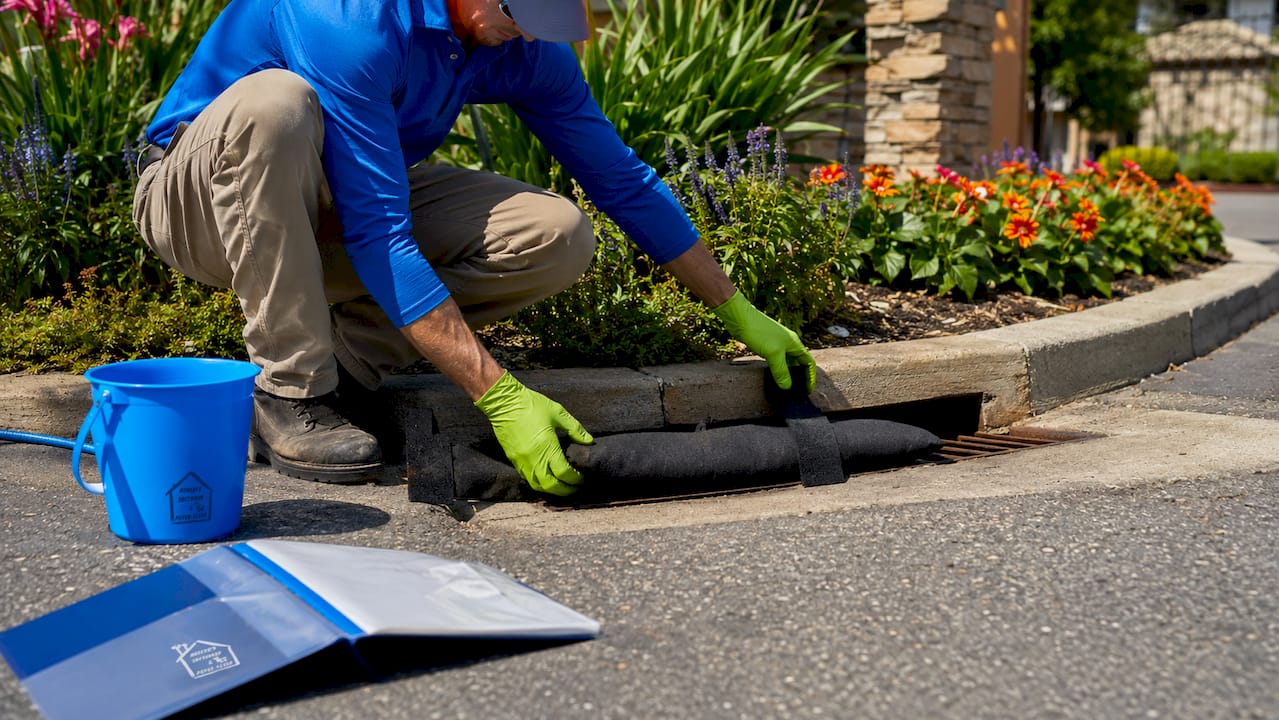
Contractors working on your property must document their wash water management plan in writing. Verbal assurances are not sufficient. Ask for a site-specific plan that identifies the drain locations, the containment method, and the disposal route before any work begins.
Pro Tip: When reviewing a contractor’s quote, request a written wash water management plan as a condition of the contract. If they cannot produce one, that is a compliance risk you are absorbing, not them.
2. Meet WHMIS and chemical exposure requirements under Ontario law
Chemical handling in exterior cleaning is governed by Ontario Regulation 860 (WHMIS) and Regulation 833 (Control of Exposure to Biological or Chemical Agents). Both regulations require employers and contractors to maintain current Safety Data Sheets (SDSs), apply up-to-date WHMIS labels on all chemical containers, and deliver site-specific WHMIS training for every chemical used on that particular job. Generic WHMIS certification cards do not satisfy this requirement.
Exterior cleaning chemicals such as Sodium Hypochlorite (used in soft washing), sodium hydroxide (degreaser applications), and acid-based cleaners (used in interlock or concrete washing) each carry distinct exposure risks. MLITSD inspectors reviewing a cleaning contractor’s compliance will look for documented procedures specific to each of those chemicals, not a blanket certificate. The distinction matters because the control measures for Sodium Hypochlorite differ from those for an acid wash product, and inspectors know this.
- Confirm the contractor holds current WHMIS training records tied to the specific chemicals they will use on your site.
- Request copies of the SDSs for every product before work begins and keep them on file.
- Verify that chemical containers arriving on site carry current WHMIS-compliant labels.
- Confirm that documented exposure control procedures exist for each chemical, including personal protective equipment (PPE) requirements and emergency response steps.
Pro Tip: Do not accept a generic WHMIS certificate as proof of compliance. Ask for the training records that name the specific chemicals and the date of the most recent SDS review. This is what MLITSD inspectors review during site visits.
3. Manage lead paint disturbance on pre-1978 properties
Any exterior cleaning work on a structure built before 1978 carries the potential to disturb lead-based paint, and that disturbance triggers federal EPA RRP Rule requirements. The threshold that activates compliance is disturbance of more than 20 square feet of exterior painted surface. Pressure washing old paint, scraping during prep, or even aggressive soft washing on deteriorated surfaces can cross that threshold quickly. The consequences of ignoring this are severe. Non-compliance with the EPA RRP Rule can result in fines up to $49,772 per violation per day, plus criminal penalties including imprisonment.
The compliance steps are specific and non-negotiable. The firm performing the work must hold EPA RRP firm certification. The individual supervising the job must hold renovator certification. Before work begins, the property owner must receive the “Renovate Right” pamphlet and sign an acknowledgement. During the job, plastic sheeting containment must be installed to capture all debris and wash water. Cleanup requires a HEPA vacuum, and a visual inspection plus wet wipe verification must confirm no hazardous residue remains.
Records from every RRP-compliant job must be retained for a minimum of three years. This includes the pre-work notification, the signed pamphlet acknowledgement, the containment setup records, and the post-work verification results.
Lead paint disturbance on pre-1978 structures requires treating the entire cleaning job as a contained work site with the same rigour applied to a renovation project. Property managers who skip this step because the work “looks like just a wash” are the ones who receive the largest fines.
4. Prepare your property for exterior cleaning compliance inspections
Structured exterior cleaning programmes and routine documentation are the most reliable way to stay inspection-ready without scrambling before an audit. Inspectors reviewing exterior cleaning compliance look at three areas: wash water management records, chemical safety documentation, and lead paint compliance files. If any of those three folders are empty, the inspection outcome is predictable.
The table below outlines the most common inspection checklist items and the preparatory actions that address each one.
| Inspection item | Recommended preparatory action |
|---|---|
| Wash water containment evidence | Keep contractor’s written wash water management plan on file with date and site address |
| Storm drain protection records | Photograph drain covers in place before and after each cleaning job |
| WHMIS training documentation | Collect site-specific training records naming each chemical used, not generic certificates |
| SDS availability | Maintain a current SDS binder or digital folder accessible on site during cleaning work |
| Lead paint compliance file | Retain RRP pamphlet acknowledgements, containment records, and verification results for three years |
| Cleaning schedule log | Record dates, scope, contractor name, and method for every exterior cleaning activity |
Treating exterior cleaning as a scheduled maintenance task rather than a reactive one changes your compliance posture entirely. A property that has documented cleaning activity every six months, with contractor records attached, presents very differently to an inspector than one with no records at all.
Pro Tip: Create a simple digital folder for each property with subfolders for wash water plans, chemical records, and lead paint files. Update it after every cleaning job. This takes ten minutes and eliminates hours of scrambling during an inspection.
5. Choose the right exterior cleaning method for compliance and surface protection
The cleaning method you select determines both the compliance obligations you trigger and the risk of surface damage. The four methods most commonly used in Southern Ontario are pressure washing, soft washing, chemical-free cleaning, and manual cleaning. Each carries a different compliance profile.
| Method | Best use | Compliance consideration | Key limitation |
|---|---|---|---|
| Pressure washing | Concrete, interlock, driveways | High runoff volume; drain protection required | Can damage wood, stucco, aged paint |
| Soft washing | Siding, roofs, fences, decks | Chemical handling and WHMIS compliance required | Requires proper chemical dilution and disposal |
| Chemical-free cleaning | Sensitive surfaces, near water features | Lowest regulatory burden | Less effective on heavy biological growth |
| Manual cleaning | Spot cleaning, graffiti removal | Minimal runoff; low compliance complexity | Labour-intensive for large areas |
Soft washing uses low pressure combined with diluted Sodium Hypochlorite or other biocidal solutions to kill algae, mould, and mildew at the source rather than blasting them off. This approach generates less runoff volume than pressure washing, which reduces the risk of triggering MECP environmental permission thresholds. The trade-off is that chemical handling compliance under WHMIS becomes the primary obligation. Understanding how soft washing works before selecting it for a sensitive surface helps you ask the right questions of any contractor you hire.
Pressure washing is the right choice for hard, durable surfaces such as concrete driveways, interlock, and commercial loading docks. The higher water volume demands rigorous drain protection and, on large commercial sites, a review of whether MECP environmental permissions apply. For pre-1978 properties, pressure washing carries the highest risk of triggering RRP lead paint compliance because the force can dislodge deteriorated paint across a large area quickly.
Key takeaways
Exterior cleaning compliance in Southern Ontario is determined by three non-negotiable controls: wash water containment, chemical-specific WHMIS documentation, and lead paint management on pre-1978 structures.
| Point | Details |
|---|---|
| Wash water is the primary compliance risk | Block storm drains before work begins and document the containment method in writing. |
| Generic WHMIS certificates are not enough | Require site-specific training records naming each chemical and the current SDS review date. |
| Pre-1978 properties trigger RRP requirements | Lead paint disturbance over 20 square feet requires firm certification, containment, and three-year record retention. |
| Documentation is your inspection defence | Maintain a cleaning log with contractor records, wash water plans, and chemical files for every job. |
| Method selection affects compliance obligations | Soft washing reduces runoff volume; pressure washing demands stricter drain protection on large sites. |
What I have learned managing compliance on Southern Ontario properties
After working with property owners and managers across Southern Ontario, the pattern I see most often is not wilful non-compliance. It is the assumption that hiring a contractor transfers all compliance responsibility to them. It does not. The property owner remains the responsible party under Ontario’s Environmental Protection Act and the Occupational Health and Safety Act when work occurs on their site.
The second most common failure is accepting a generic WHMIS certificate as proof that chemical handling is covered. Requiring contractors to provide site-specific training records is the standard that actually satisfies an MLITSD inspection. The difference between a passed inspection and a stop-work order often comes down to that single document.
The property managers I have seen handle compliance well share one habit: they treat exterior cleaning the same way they treat a fire safety inspection. They schedule it, document it, and keep the records. They also ask contractors the right questions before signing anything. If a contractor cannot explain their wash water management plan or their lead paint protocol for a pre-1978 building, that is the answer you need before the work starts, not after.
Building a compliance culture in your team means making these questions routine, not exceptional. A seasonal exterior cleaning programme with documented contractor vetting built into the process is far less costly than a single regulatory fine.
— Felix
How Mercerssoftwashpowerclean supports compliant exterior cleaning in Southern Ontario
Mercerssoftwashpowerclean provides professional soft washing and pressure washing services for residential and commercial properties across Southern Ontario, with wash water management and chemical safety built into every job. The team understands Ontario MECP requirements, WHMIS obligations, and the surface-specific demands of properties ranging from heritage homes to commercial facilities. Whether you need soft washing vs pressure washing guidance to choose the right method, or a contractor who can provide the documentation your inspection file requires, Mercerssoftwashpowerclean delivers the service and the paperwork. Contact the team to discuss your property’s compliance needs and schedule a cleaning programme that keeps you protected year-round.
FAQ
What triggers an environmental permission requirement for exterior cleaning in Ontario?
Ontario’s MECP requires an ECA or EASR when wash water collection, treatment, or discharge meets the definition of sewage works and design capacity exceeds 10,000 litres per day. Large commercial washing jobs are the most likely to reach this threshold.
Does WHMIS training need to be chemical-specific for exterior cleaning contractors?
Yes. Ontario Regulation 860 requires training tied to the specific chemicals used on each site, supported by current SDSs and WHMIS-compliant labels. A generic WHMIS certificate does not satisfy MLITSD inspection requirements.
When does the EPA RRP Rule apply to exterior cleaning work?
The EPA RRP Rule applies when exterior cleaning disturbs more than 20 square feet of painted surface on a structure built before 1978. Compliance requires firm certification, renovator certification, containment, HEPA cleanup, and records kept for at least three years.
What records should a property manager keep for each exterior cleaning job?
Keep the contractor’s wash water management plan, storm drain protection photographs, site-specific WHMIS training records, SDSs for all chemicals used, and any lead paint compliance documents. A structured cleaning log with dates and contractor details rounds out a complete inspection-ready file.
Is soft washing a more compliant option than pressure washing for residential properties?
Soft washing generates less runoff volume than pressure washing, which reduces the risk of triggering MECP environmental permission thresholds. The primary compliance obligation shifts to chemical handling under WHMIS, which is manageable with proper documentation and contractor vetting.


