

Knowing how to pressure wash wood deck safely is the difference between a clean, refreshed surface and one you will need to replace within a few seasons. Many homeowners grab the highest PSI setting and go at their deck like they are blasting concrete, and the results are splintered boards, raised fibres, and permanent streaking that no amount of sanding can fully fix. The good news is that with the right tools, realistic pressure settings, and a methodical approach, pressure washing wooden decks is a straightforward process. This guide covers everything you need to know before you pull the trigger.
Key takeaways
| Point | Details |
|---|---|
| PSI matters by wood type | Softwoods need 500–1,200 PSI; hardwoods tolerate up to 1,500 PSI before splintering risk increases. |
| Nozzle choice is critical | Use a 25° or 40° fan tip and keep 12–18 inches from the surface to prevent etching. |
| Chemical prep comes first | Apply an oxygenated deck cleaner before washing; pressure alone cannot safely lift embedded dirt. |
| Always wash with the grain | Moving the nozzle along the wood grain prevents cross-fibre damage and uneven stain removal. |
| Aftercare protects the wood | Allow 48–72 hours of drying time before applying sealant to avoid blistering and peeling. |
Tools and materials needed
Getting your equipment right before you start is what separates a professional result from a frustrating one. The single most important number to understand is PSI, or pounds per square inch. Softwoods like pine and cedar need no more than 500 to 1,200 PSI, while hardwoods such as ipe or composite-adjacent tropical species can handle up to 1,800 PSI, though staying at or below 1,500 PSI is the standard recommendation to protect fibres. If you are using a rented machine and cannot verify the output, always start at the lower end.
Nozzle selection deserves as much attention as pressure settings. A 25° or 40° wide fan nozzle is what you want for deck surfaces. The 0° red tip concentrates the stream into a single point of force and will gouge or etch wood fibres with almost no effort. Avoid it entirely. A rotating turbo nozzle is also too aggressive for most wood types.
Here is a practical list of what you should have ready before you begin:
- A gas or electric pressure washer rated between 1,200 and 2,000 PSI with adjustable settings
- 25° and 40° fan spray nozzles
- Safety goggles, non-slip footwear, and waterproof gloves
- A stiff-bristled deck brush for pre-scrubbing
- An oxygenated deck cleaner (sodium percarbonate-based products are the industry standard)
- A garden hose for rinsing and pre-wetting
- Painter’s tape or plastic sheeting to protect nearby plants and siding
Pro Tip: Before committing to a full wash, always test your pressure on a small, inconspicuous section of the deck. Starting on a hidden spot first lets you gauge how the wood responds and adjust your PSI or nozzle angle before any visible damage can occur.
When it comes to cleaning agents, oxygenated cleaners using sodium percarbonate are the preferred choice for lifting dirt, mould, and mildew from wood safely. Chlorine bleach and trisodium phosphate (TSP) are too aggressive for wood fibres and can cause discolouration, weakened grain, and long-term degradation. Choose a product labelled specifically for wood decks.
| Tool | Recommended specification |
|---|---|
| Pressure washer | 1,200–2,000 PSI, adjustable |
| Spray nozzle | 25° or 40° fan tip |
| Deck cleaner | Sodium percarbonate (oxygenated) |
| Spray distance | 12–18 inches from surface |
| Safety gear | Goggles, gloves, non-slip footwear |
Preparing your deck before washing
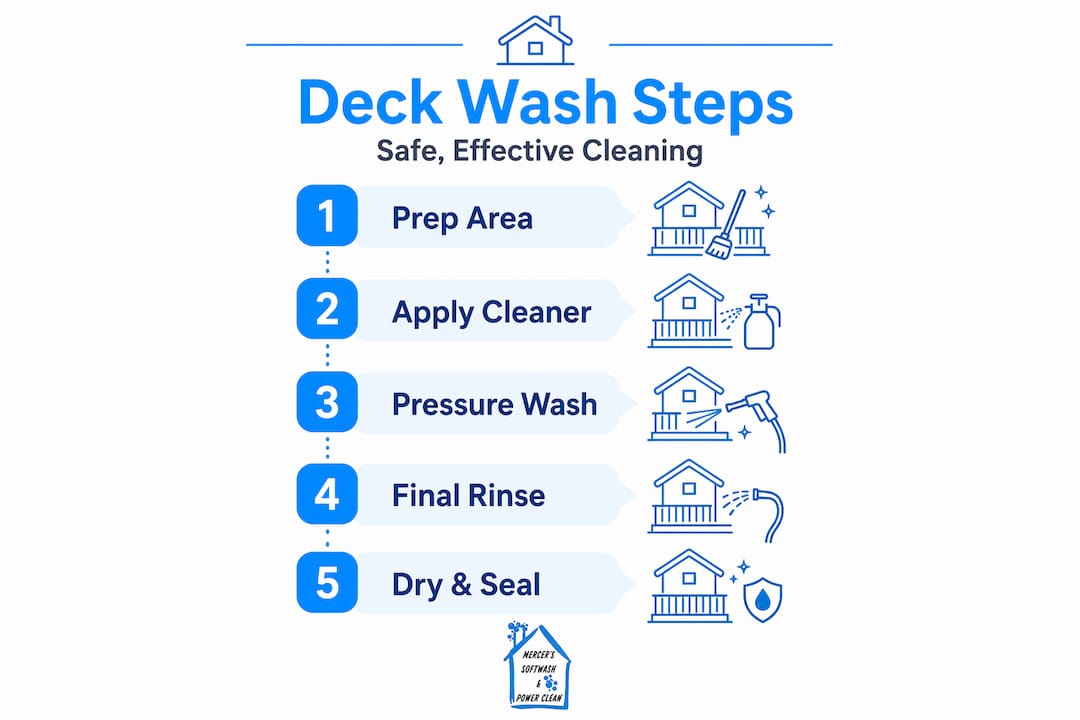
Preparation is where most DIY deck cleaning attempts either succeed or fail. Skipping this stage and going straight to pressure washing guarantees uneven results at best and structural damage at worst.
Start by completely clearing the deck. Remove all furniture, planters, grills, and decorative items. If any items are too heavy to move alone, slide cardboard underneath them to protect the boards from scratching. Next, do a thorough visual inspection of the entire surface.
- Walk the full perimeter and check every board for rot, cracks, loose nails, or raised screws. Pressure washing over compromised wood accelerates damage dramatically, so flag any problem boards for repair before you proceed.
- Sweep off all loose debris, leaves, and dry dirt with a stiff broom. This dry pre-cleaning removes material that would otherwise turn to muddy runoff and redeposit on the wood during washing.
- Apply your chosen oxygenated deck cleaner according to the manufacturer’s directions, typically diluted with water and distributed evenly across the deck surface. Pressure washing works as a rinse method designed to flush out dirt that chemicals and scrubbing have already loosened. The cleaner does the actual lifting; the pressure washer does the rinsing.
- Work the cleaner into the surface using your stiff-bristled deck brush, paying particular attention to areas with visible mould growth or dark staining between boards.
- Let the solution sit for the time specified on the product label, typically 10 to 15 minutes, then pre-wet the entire deck with a garden hose before bringing out the pressure washer. Pre-wetting prevents the wood from absorbing the cleaner unevenly and helps the pressure washing process stay consistent.
Pro Tip: Cover nearby garden beds and low shrubs with plastic sheeting before applying any cleaning solution. Even oxygenated cleaners can affect sensitive plants when runoff concentrates around root zones, particularly on smaller garden patches.
Proper technique for pressure washing wood
This is where the real skill lies, and where pressure washing is primarily a rinse becomes most relevant. Your job with the pressure washer is to flush the loosened dirt away cleanly, not to blast embedded grime out through brute force.
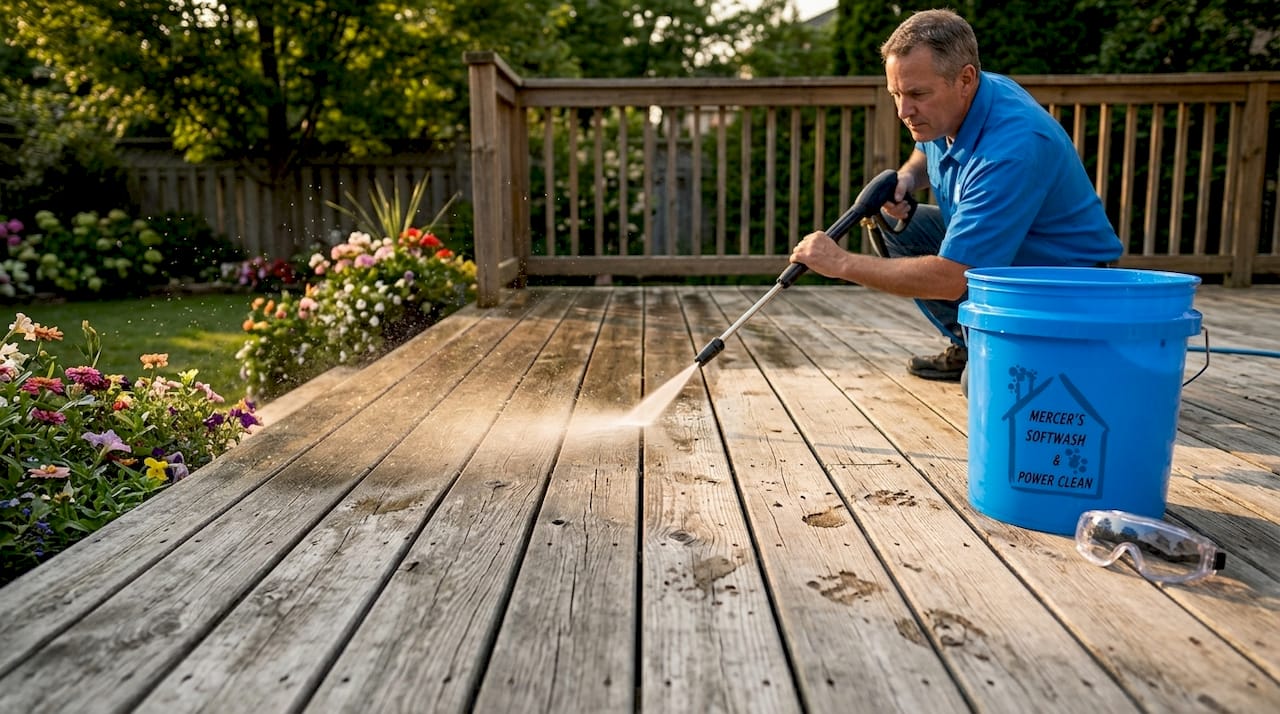
Maintain a consistent spray distance of 12 to 18 inches from the surface. Getting closer than 12 inches increases pressure exponentially at the wood surface, even with low PSI settings on the machine. Getting further than 18 inches reduces your cleaning effectiveness and often results in streaking.
Always move the nozzle in the same direction as the wood grain. Moving across the grain tears individual fibres and creates visible scratch patterns that worsen over time. Keep your stroke long, smooth, and deliberate, sweeping from one end of the board to the other in a single consistent pass.
Avoid stopping or starting the spray stream while the nozzle is pointed directly at the wood. On-board start and stop actions create harsh gouges and visible cross-lines that are nearly impossible to remove. Begin each pass with the nozzle moving over the board edge, not on top of it.
Watch the wood surface carefully as you work. Fuzzy or beard-like fibres appearing on the surface during washing are an immediate signal that the pressure is too high or the nozzle is too close. Stop the moment you see this, increase your distance by four to six inches, or reduce your PSI setting before continuing. Continuing past this point causes irreversible surface damage.
Pro Tip: Move at a walking pace and overlap each pass by about two to three inches. Overlapping passes prevent the faint vertical stripes that appear when you wash in perfectly adjacent strips without any transition zone.
After washing the full deck surface, do a thorough rinse pass with the 40° nozzle at low pressure, using the same grain-following direction. This final rinse clears any residual cleaner from the wood and reduces the chance of soap residue affecting how sealant bonds later.
Aftercare to protect your deck
The work is not finished once you put the pressure washer away. What you do in the days following the wash has a direct bearing on how long your deck stays clean, sealed, and structurally sound.
The most important aftercare step is drying time. Wait 48 to 72 hours before applying any stain, sealant, or protective oil. Wood that is still holding moisture below the surface cannot absorb sealant properly, and the result is blistering, peeling, and premature coating failure. Two to three dry days is the standard, though humidity and shade can extend this.
Once the deck is fully dry, check the surface for any raised grain or rough patches. Light sanding with 80-grit sandpaper smooths these areas and gives the sealant a better surface to bond with. Wipe away all sanding dust before applying any product.
When choosing a sealant, oil-based penetrating sealers work well on older or weathered wood because they soak into the grain rather than sitting on top of it. Film-forming sealers offer stronger water repellence but need more thorough surface prep to avoid peeling. For decks in shaded or damp areas, an anti-mould or anti-moss additive mixed into the sealer reduces the time between necessary cleans.
Skipping the sealing step entirely is one of the most common ways homeowners unknowingly shorten their deck’s lifespan. A freshly washed and opened wood grain without protection absorbs moisture rapidly, which accelerates rot, warping, and greyening of the surface within a single season.
Troubleshooting common pressure washing mistakes
Even experienced homeowners run into problems during or after a deck wash. Knowing how to identify and correct them quickly prevents minor issues from becoming expensive ones.
- Splintering or surface gouging: This is the direct result of higher pressure than wood tolerates. Many homeowners assume that more pressure means a better clean, which is the opposite of how wood responds. If you see gouging, reduce PSI and increase spray distance immediately.
- Streaking or uneven stain removal: Usually caused by inconsistent spray distance, moving across the grain, or rushing through passes. Go back over affected areas at a slower pace, following the grain strictly and maintaining even distance throughout.
- Water infiltration and early rot: Concentrating the spray in one spot or using too high a PSI on older boards can drive water deep into the wood and into the sub-structure underneath. If you notice any boards that feel soft or spongy after washing, those need assessment for rot before sealing.
- Boards greying faster than expected after cleaning: Often a sign that the sealant was applied before the wood was fully dry, causing the coating to fail and the wood to weather unprotected.
Different wood types behave very differently under pressure. Older, weathered pine is far more vulnerable than fresh pressure-treated lumber. If your deck is more than seven to ten years old or shows significant greying, softer pressure and longer chemical dwell times will serve you far better than increased force.
When you encounter significant rot, structural damage, or a large deck with heavily variable board conditions, that is the point at which a professional deck washing service will deliver better results and far less risk than continuing with DIY methods. Professional-grade equipment with consistent pressure and specialised nozzles reduces risk and improves uniformity significantly compared to consumer rental machines.
My perspective on safe deck washing
In my experience, the biggest mistake homeowners make is not choosing the wrong nozzle or the wrong PSI. It is rushing. People allocate two hours to clean a deck that genuinely needs a full day to do properly, including prep, chemical dwell time, washing, and inspection. When you rush, you skip the test patch, you do not pre-apply cleaner, and you end up compensating with more pressure to get results faster. That is how decks get ruined.
I have seen decks with soft pine boards that were washed at 1,800 PSI because the homeowner assumed higher was better. The boards looked furry and felt like rough velvet to the touch within one pass. There is no fix for that except sanding down and refinishing, which costs far more than doing it right the first time would have.
The other thing I want to highlight is respecting the grain. I cannot overstate how much of a difference washing with the grain versus against it makes to the final result. Against the grain looks like someone scratched the deck with wire wool. With the grain, the boards come out looking almost new. It is one small habit that changes everything.
If you are uncertain about your wood type, its age, or its current condition, have someone qualified assess it before you start. Knowing the difference between soft washing and pressure washing for different surfaces will also help you make the right call from the beginning.
— Felix
Let Mercerssoftwashpowerclean handle your deck
If you have followed this guide and are still not confident about tackling your deck safely, or if your deck is older, larger, or made of a sensitive wood species, that is a completely reasonable place to be. Mercerssoftwashpowerclean works with homeowners across Southern Ontario to deliver professional deck and fence washing using controlled pressure, correct PSI settings, and oxygenated cleaning agents that protect wood fibres. For homeowners in the region, the Cobourg pressure washing service and Oshawa pressure washing teams also handle full exterior cleans, from decks and fences to siding and roofs. Get in touch to discuss your deck’s condition and what safe cleaning approach fits it best.
FAQ
What PSI is safe for pressure washing a wood deck?
Softwoods like pine and cedar require 500 to 1,200 PSI to avoid fibre damage, while hardwoods can tolerate up to 1,500 PSI. Staying within these ranges and testing on a small area first is the safest approach.
Can I pressure wash a wood deck without a cleaning solution?
Pressure washing alone acts as a rinse and will not safely remove embedded dirt, mould, or mildew. Applying an oxygenated deck cleaner first and scrubbing it in gives the pressure washer something to flush away, producing a deeper and safer clean.
How far should I hold the pressure washer from my wood deck?
Maintain a spray distance of 12 to 18 inches from the deck surface. Getting closer intensifies the force significantly and can etch or splinter wood fibres even at lower PSI settings.
How long should I wait after pressure washing before sealing?
Allow 48 to 72 hours of drying time before applying any sealant or stain. Sealing too early traps moisture in the wood, which causes blistering and premature coating failure.
What are the signs that I am damaging my deck while washing?
Fuzzy or raised fibres on the wood surface are the clearest sign that pressure is too high or the nozzle is too close. Stop immediately, increase your distance, reduce PSI, and assess the affected boards before continuing.
Recommended
- Deck & Fence Power Washing – Mercer’s Softwash & Power Clean Inc. | Pressure Washing Service
- Soft wash house siding guide for homeowners
- Pressure Washing Oshawa Sevices, ON | Mercer’s Softwash
- What Is The Difference Between Soft Washing And Pressure Washing In Port Hope? – Mercer’s Softwash & Power Clean Inc. | Pressure Washing Service


