

House washing is the professional cleaning of a home’s exterior surfaces using specialised chemical solutions and low-pressure water application to safely remove dirt, mould, mildew, algae, and other biological contaminants. Unlike a simple rinse with a garden hose, a proper house washing service combines chemistry and controlled water delivery to address the root cause of staining and organic growth. The primary method used by professionals is soft washing, which relies on sodium hypochlorite and surfactants rather than brute water pressure. Understanding what house washing includes helps you make informed decisions, ask the right questions, and protect your property from both biological damage and improper cleaning techniques.
What does house washing include: surfaces and scope
A professional house washing service covers far more than just the walls you can see from the street. Standard service scope typically includes exterior walls and siding, windows and doors, eaves, soffits, fascias, gutters, and sometimes decks or driveways depending on the provider and package.
The type of surface determines both the method and the chemical concentration used. Vinyl siding, stucco, brick, and wood each respond differently to cleaning agents and water pressure, so a one-size-fits-all approach causes more harm than good. A reputable provider will assess each surface individually before applying any solution.
Here is what is typically covered in a full house washing service:
- Exterior walls and siding: Vinyl, stucco, brick, and wood siding are cleaned to remove mould, algae, and dirt accumulation.
- Windows and doors: Exterior surfaces, frames, and surrounds are washed to remove grime and biological growth. For a full breakdown of what this involves, the window cleaning process is worth reviewing separately.
- Eaves, soffits, and fascias: These areas trap moisture and organic debris, making them prime locations for mould and mildew growth.
- Gutters: Exterior gutter faces are cleaned of black streaking and oxidation staining.
- Decks, driveways, and walkways: These are often offered as add-on services and may involve pressure washing rather than soft washing depending on the surface material.
The scope of your service should be confirmed in writing before work begins. Knowing exactly which surfaces are included prevents misunderstandings and helps you compare quotes accurately.
What are the steps in a professional house washing process?
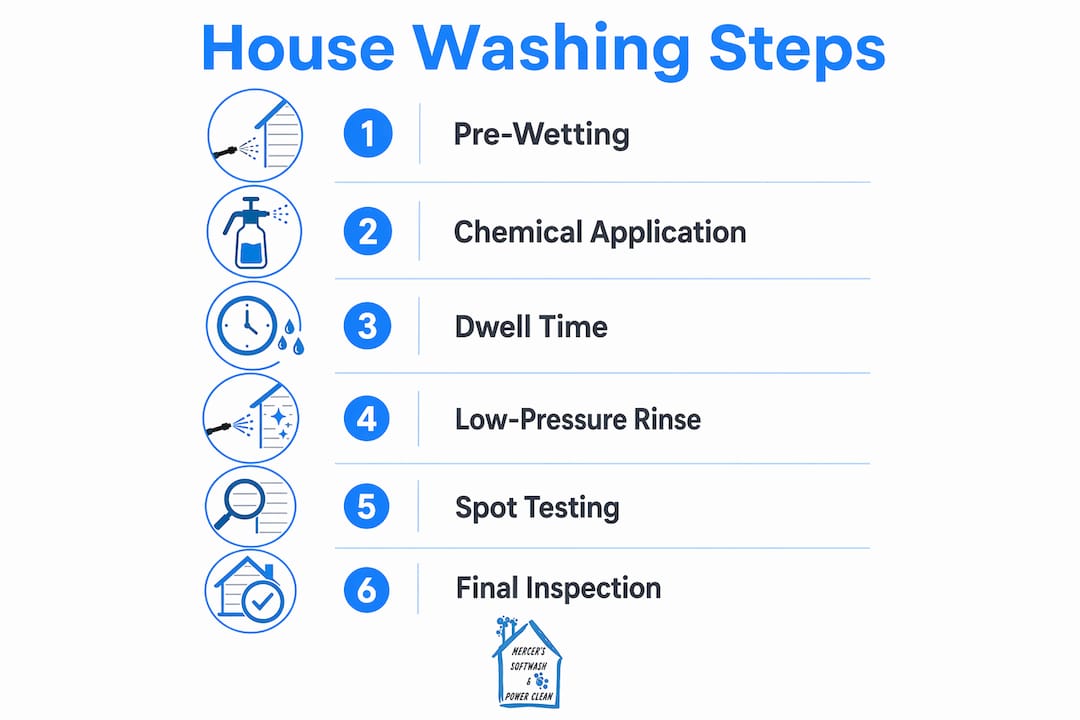
The house washing process follows a structured sequence designed to protect your property while delivering a thorough clean. Skipping any step, particularly the plant protection steps, can result in chemical damage to landscaping or incomplete cleaning results.
-
Property inspection and surface assessment. A pre-walk inspection maps the surface types, organism load, and any vulnerable areas before a single drop of chemical is applied. This step determines the correct chemical mix and pressure settings for each zone of the property.
-
Pre-saturation of plants and landscaping. Before chemicals are applied, all plant beds, shrubs, and grass within drift distance are thoroughly soaked with fresh water. This dilutes any chemical contact and reduces the risk of foliar damage.
-
Chemical mixing and preparation. The cleaning solution is mixed to the appropriate concentration for the surfaces being treated. Sodium hypochlorite is the primary active ingredient, combined with a surfactant that increases dwell time and improves surface contact.
-
Application via soft wash system. The solution is applied at low pressure, often at or below garden hose PSI, using a dedicated soft-wash applicator. This ensures even coverage without forcing water behind cladding or into window seals.
-
Dwell time. The chemical solution is allowed to sit on the surface for a defined period. Dwell times typically range from 5 to 25 minutes depending on the surface type and the severity of biological growth. This is the stage where sodium hypochlorite oxidises and kills mould, algae, and mildew at the cellular level.
-
Top-down rinsing. The property is rinsed from the highest point downward using a controlled, high-volume but low-pressure water flow. This removes chemical residue and dislodged organic matter without driving water into the building envelope.
-
Post-rinse plant care. After the main rinse, all plant beds and landscaping are flushed again with fresh water to neutralise any residual chemical that may have settled during the wash.
Pro Tip: Ask your provider how long they allow for dwell time on your specific siding material. A technician who cannot answer this question has likely not been trained to adjust their process by surface type.
What chemicals and equipment are used in house washing?
Professional house washing relies on a small number of well-understood chemicals applied with purpose-built equipment. The chemistry is straightforward, but the concentration and application method make the difference between a safe, effective clean and surface damage.
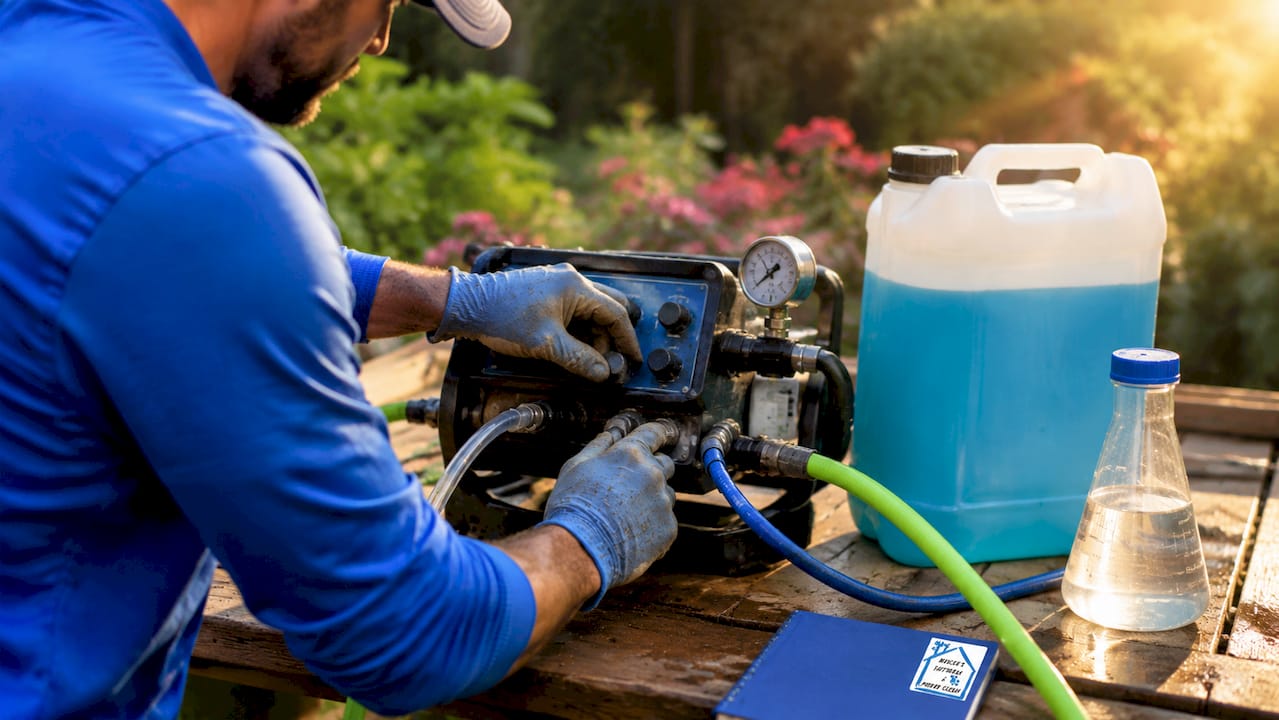
Sodium hypochlorite is the primary biocide used in soft washing. It kills mould, algae, mildew, and lichen by oxidising the organisms at a cellular level rather than simply washing them off the surface. Soft washing kills organic growth at the root, which is why results last significantly longer than pressure washing alone.
Surfactants are added to the mix to reduce surface tension, allowing the solution to cling to vertical surfaces longer and penetrate porous materials more effectively. Without a surfactant, the chemical runs off too quickly to complete the biological kill cycle.
The table below outlines typical sodium hypochlorite concentrations by surface type:
| Surface type | Recommended SH concentration |
|---|---|
| Vinyl siding | 0.5–1.5% |
| Stucco and EIFS | 0.25–0.5% |
| Brick and concrete | 2–4% |
| Asphalt shingles | Up to 5% |
These concentration ranges by surface reflect the porosity and chemical tolerance of each material. Applying brick concentrations to stucco, for example, risks discolouration and surface etching. A professional who understands this distinction is worth the investment. For a deeper look at how these solutions are applied to siding specifically, the soft wash siding guide from Mercerssoftwashpowerclean covers this in detail.
Equipment includes soft-wash pumps, low-pressure delivery guns, and downstream injectors. These systems are purpose-built to apply chemical solutions at controlled pressures, unlike standard pressure washers which are designed to deliver force rather than chemistry.
Pro Tip: A professional soft-wash kit includes sodium hypochlorite at 1–3%, a surfactant, and a dedicated rinse step using high water volume without high pressure. If your provider is using a standard pressure washer with no chemical injection, they are pressure washing, not soft washing.
Soft washing vs pressure washing: which method is right?
The distinction between soft washing and pressure washing is one of the most misunderstood aspects of house washing services. Both methods have a place in a professional exterior cleaning programme, but they are not interchangeable.
Soft washing applies biodegradable cleaning solutions at low pressure, often less than 500 PSI, to kill and remove organic growth through chemistry rather than force. Pressure washing uses high-pressure water, typically 1,500 to 4,000 PSI, to physically blast dirt and debris from surfaces. The right choice depends entirely on the surface material and the type of contamination being addressed.
| Method | Pressure used | Best for | Risk level |
|---|---|---|---|
| Soft washing | Under 500 PSI | Siding, roofs, stucco, painted surfaces | Low |
| Pressure washing | 1,500–4,000 PSI | Concrete, brick, pavers, driveways | Moderate to high |
High pressure can damage delicate surfaces like vinyl siding and stucco by forcing water behind cladding, stripping paint, or etching the surface material. This damage is often invisible immediately after cleaning but becomes apparent within weeks as moisture intrusion causes swelling, peeling, or mould growth behind the wall.
A well-rounded house washing service uses both methods selectively. Soft washing handles the walls, soffits, and any painted or coated surfaces. Pressure washing is reserved for hard surfaces like concrete driveways, interlock, and brick walkways where high-pressure water is appropriate and effective. For a full comparison of when each method applies, soft washing vs pressure washing is a useful reference.
What added services and protections are often part of house washing?
Beyond the core wash, professional house washing services include several protective and supplementary steps that separate a thorough job from a superficial one. These elements are worth confirming with any provider before booking.
Plant pre-wetting and post-rinsing are standard in professional workflows. Pre-saturating plants before chemical application and rinsing them again after the wash prevents chemical uptake through roots and foliage. Providers who skip this step risk killing shrubs and garden beds, which is a costly and avoidable outcome.
Spot testing is another protective measure used on unfamiliar or older surfaces. A small test area is treated first to confirm the chemical concentration does not cause discolouration or surface reaction before the full application proceeds. This is particularly relevant for older painted surfaces, natural stone, and heritage brick.
Window exterior cleaning is included in many full-service house washes, covering the glass, frames, and sills. This is worth confirming, as some providers treat windows as a separate line item. The benefits of regular exterior cleaning extend well beyond appearance, including the prevention of long-term surface degradation caused by biological growth.
Frequency recommendations vary by region and exposure. In Southern Ontario, most residential properties benefit from a full house wash every one to two years, with more frequent attention for north-facing walls and heavily shaded areas where moisture and algae accumulate faster.
Key takeaways
A complete house washing service combines soft washing chemistry, surface-specific chemical concentrations, and structured plant protection to safely clean a home’s exterior from top to bottom.
| Point | Details |
|---|---|
| Soft washing is the core method | Low-pressure chemical application kills mould and algae at the root for lasting results. |
| Chemical concentration varies by surface | Vinyl requires 0.5–1.5% SH; brick and concrete can tolerate 2–4% without damage. |
| Plant protection is non-negotiable | Pre-wetting and post-rinsing landscaping prevents chemical damage to roots and foliage. |
| Dwell time determines effectiveness | Allowing 5–25 minutes of contact time is what separates a proper clean from a surface rinse. |
| Scope should be confirmed in writing | Standard inclusions vary by provider; confirm surfaces, chemicals, and plant care before booking. |
What I’ve learned about what homeowners actually get from house washing
From my experience working in exterior cleaning across Southern Ontario, the gap between what homeowners expect and what they actually receive from a house washing service often comes down to one thing: whether the provider treats every job as a chemistry problem or just a water pressure problem.
The most common mistake I see is providers applying a single chemical concentration to every surface on a property. Stucco and vinyl siding are not the same material, and treating them identically either under-cleans or damages one of them. A properly adapted chemical mix by substrate is not optional. It is the foundation of safe, effective house washing.
Plant protection is the other area where shortcuts are most visible after the fact. Dead shrubs and brown grass along the foundation are a clear sign that pre-wetting and post-rinsing were skipped. These steps add time to the job, which is exactly why some providers omit them.
My advice to any homeowner booking a house wash: ask specifically what concentration of sodium hypochlorite will be used on your siding, how long the dwell time will be, and what plant protection steps are included. A provider who can answer those questions clearly and confidently is one who knows what they are doing. One who deflects or gives vague answers is one worth walking away from.
— Felix
Professional house washing services from Mercerssoftwashpowerclean
Mercerssoftwashpowerclean provides professional house washing services across Southern Ontario, with every job built around surface-specific chemical mixes, proper dwell times, and full plant protection protocols. The team uses dedicated soft-wash systems for siding, eaves, and windows, and pressure washing for hard surfaces like driveways and interlock, selecting the right method for each surface rather than applying one approach across the board. Chemical use is transparent, and every wash includes pre-saturation and post-rinse care for all landscaping within the work area. To understand the method behind the results, read the complete soft washing guide and see how Mercerssoftwashpowerclean approaches exterior cleaning from the ground up.
FAQ
What surfaces does house washing typically cover?
House washing typically covers exterior walls and siding, windows and doors, eaves, soffits, fascias, and gutters. Decks, driveways, and walkways are often available as add-on services depending on the provider.
Is soft washing the same as pressure washing?
Soft washing and pressure washing are distinct methods. Soft washing uses low pressure (under 500 PSI) combined with sodium hypochlorite and surfactants to kill organic growth chemically, while pressure washing uses high-pressure water (1,500 to 4,000 PSI) to physically remove dirt from hard surfaces.
How long does a house washing service take?
Most residential house washes take between two and five hours depending on the size of the property, the number of surfaces included, and the severity of biological growth. Dwell time for the chemical solution accounts for a portion of that duration.
How often should a house be professionally washed?
Most homes in Southern Ontario benefit from a full exterior wash every one to two years. North-facing walls and heavily shaded areas may require more frequent attention due to faster accumulation of moisture, mould, and algae.
Can house washing damage my plants or garden?
Properly executed house washing will not damage your landscaping. Professional providers pre-saturate all plant beds and shrubs with fresh water before applying chemicals, then rinse them again after the wash to neutralise any residual solution within drift distance.


