

Soft washing is defined as a low-pressure chemical cleaning method that removes algae, moss, and biological growth from roof shingles without stripping the protective granules that hold them together. Industry authorities including ARMA (Asphalt Roofing Manufacturers Association) and GAF endorse soft washing as the only safe roof cleaning method for asphalt shingles. Understanding how soft wash protects shingles matters because the wrong cleaning method can void your roof warranty, accelerate granule loss, and cut years off your roof’s lifespan. This guide breaks down the science, the risks, and what you need to know to keep your shingles in good shape.
How does algae damage asphalt shingles over time?
Algae is the most common threat to asphalt shingle roofs in Southern Ontario, and most homeowners do not realise how much damage it causes before it becomes visible. The most prevalent species is Gloeocapsa magma, a cyanobacterium that feeds on the limestone filler embedded in asphalt shingles. As it feeds, it loosens the granules that protect the shingle surface from UV radiation and weather. Once granules begin to shed, the underlying asphalt is exposed and deteriorates rapidly.
Biological growth also changes how your roof handles heat. Dark algae stains absorb more solar energy than a clean shingle surface, which raises attic temperatures and increases cooling costs during summer months. ARMA technical guidance confirms that while algae does not cause direct structural damage to shingles, it significantly affects energy efficiency and can trigger flags during insurance inspections. That last point surprises many homeowners. Insurance carriers reviewing your property may note untreated algae growth as a maintenance concern.
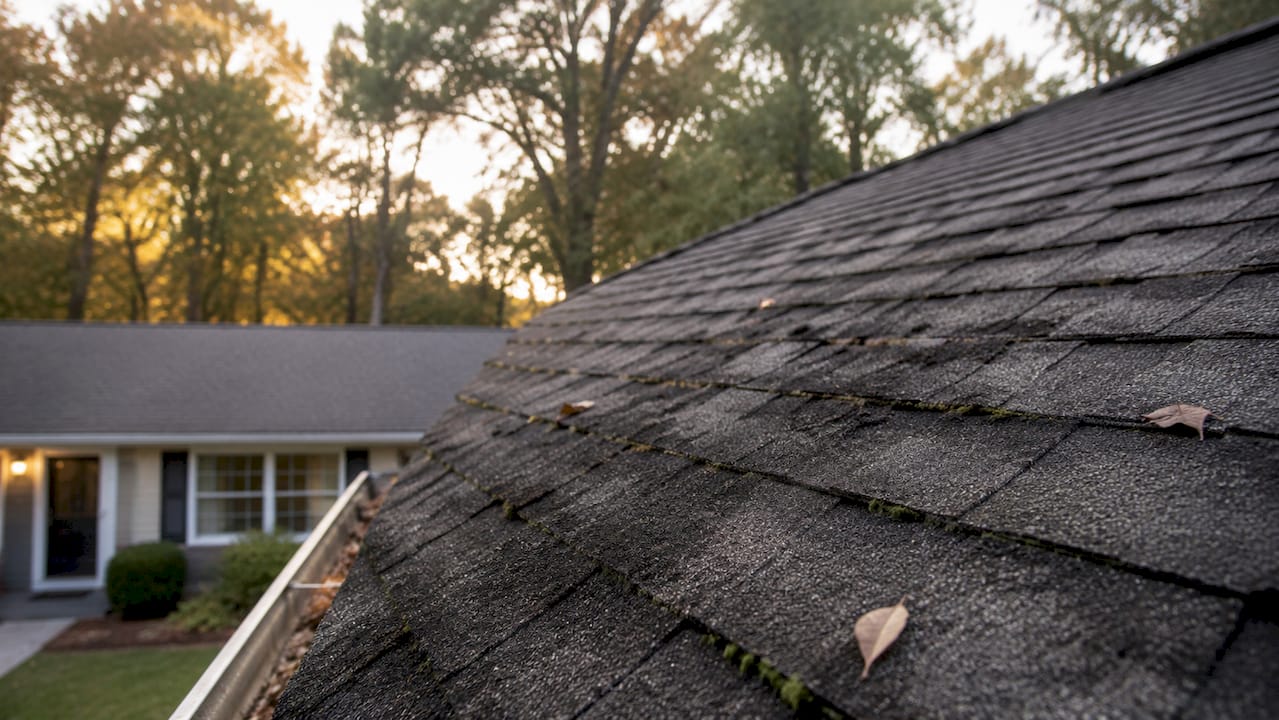
Moss presents a different but equally serious problem. Moss holds moisture against the shingle surface, which accelerates the breakdown of shingle adhesives and seal strips over time. Soft washing prevents this degradation by eliminating moss and algae before they compromise the adhesives that keep shingles sealed against wind and water. Left untreated, algae and moss together can shorten roof lifespan by 5–10 years by continuously loosening granules and trapping moisture. That is a significant reduction on what should be a 20 to 30 year investment.
If you notice dark streaks, green patches, or a rough texture developing on your shingles, those are signs your roof needs attention before the damage compounds.
Why is soft washing the only safe method for shingle roofs?
Soft washing is the only cleaning method that removes biological growth without damaging the shingles themselves. The technique keeps application pressure under 60–100 PSI at the surface, which is comparable to a standard garden hose. That level of pressure cleans without dislodging granules or forcing water beneath the shingles where it can cause rot or mould.
The real work in soft washing is done by chemistry, not force. A sodium hypochlorite solution, mixed with surfactants and water, penetrates the algae and moss at the cellular level. Sodium hypochlorite oxidises the organisms, killing them at the root rather than simply washing away the visible surface growth. This is the critical distinction between soft washing and pressure washing. Pressure washing removes what you can see. Soft washing kills what is actually causing the damage.
Manufacturer standards reinforce this. Both ARMA and GAF explicitly recommend soft washing over pressure washing for asphalt shingles. Using a pressure washer on your roof can void the manufacturer’s warranty, which means a repair or replacement claim may be denied if the damage is linked to improper cleaning. Protecting shingles with soft wash is not just good maintenance practice. It is a condition of keeping your warranty valid.
Pro Tip: Ask any contractor what PSI they use at the surface before hiring them. Some operators label 1,000 PSI as “low pressure,” but that is still far too high for asphalt shingles. Safe soft wash roof cleaning stays under 100 PSI at the surface.
Correct application technique also matters beyond pressure. Upward spray angles must be avoided because directing water beneath shingles causes water intrusion and can damage the roof deck. A trained technician applies solution in a downward direction, working with the natural drainage of the roof rather than against it.
What are the risks of pressure washing a roof?
Pressure washing a roof causes direct, measurable harm to asphalt shingles. A standard pressure washer operates between 1,500 and 4,400 PSI. Asphalt shingles are not designed to withstand that kind of force. The granules that protect shingles from UV damage are bonded to the surface, and high-pressure water strips them away in a single pass.
The damage does not stop at granule loss. High-pressure water can crack shingles, lift edges, and drive water beneath the surface into the roof deck and attic insulation. Once water intrusion begins, the repair costs escalate quickly. A pressure-washed roof may look clean immediately after treatment, but the structural integrity of the shingles is compromised.
Pressure washing also fails to solve the underlying biological problem. It removes the visible algae but leaves the spores and root structures intact in the shingle surface. Those spores regrow within weeks to six months, meaning you are back to the same problem faster than before. Soft washing results last 2–5 years because the sodium hypochlorite solution kills the organism completely. Pressure washing results last months at best.
The financial consequences compound over time. Repeated pressure washing accelerates granule loss with each treatment, shortening the roof’s serviceable life. A roof that should last 25 years may need replacement in 15 years if it is regularly pressure washed. For a full comparison of both methods, the soft washing vs pressure washing breakdown covers the key differences in detail.
How does the soft washing process work?
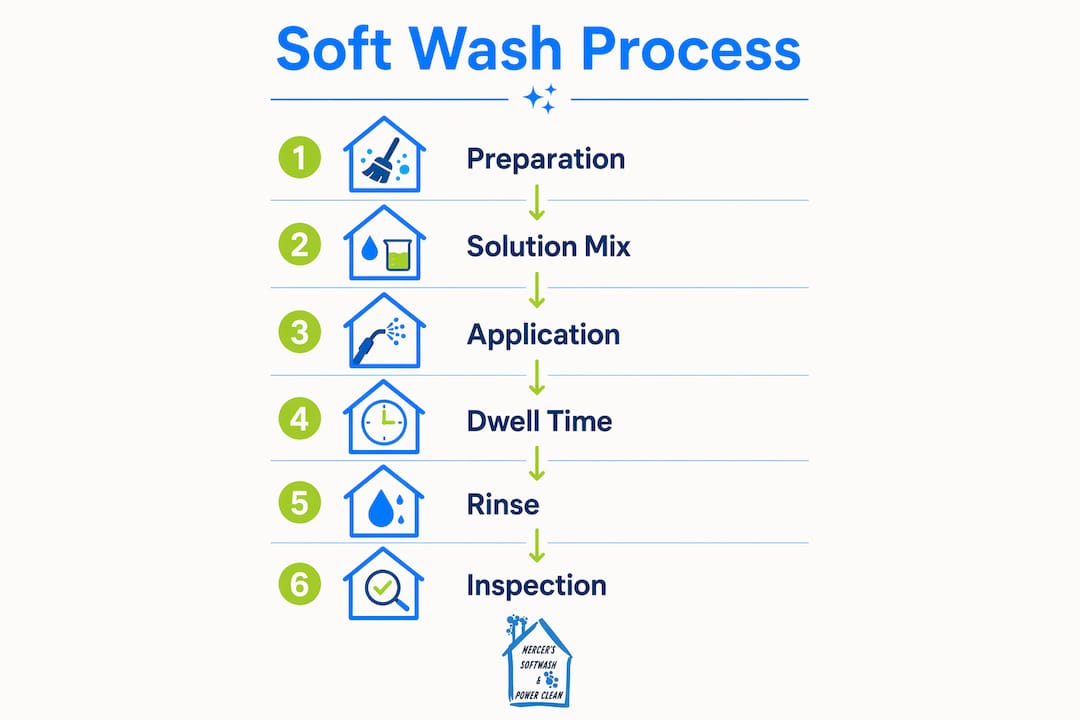
Soft washing follows a defined sequence that protects both your roof and your property. Understanding the steps helps you evaluate whether a contractor is doing the job correctly.
The process begins with preparation. Before any solution is applied, the surrounding landscaping, garden beds, and downspout areas are pre-wetted with clean water. This dilutes any chemical runoff that reaches plants and soil during the cleaning process. Pre-wetting plants and neutralising chemicals after cleaning are standard professional practices that protect your landscaping from harm.
The cleaning solution is then mixed and applied. A typical mix combines sodium hypochlorite with surfactants and water, calibrated to the level of biological growth on the roof. Surfactants help the solution cling to the shingle surface rather than running off immediately, which improves contact time and cleaning effectiveness. Application is done using a 12V soft wash pump system, which delivers solution at low pressure through dedicated soft wash nozzles.
Dwell time is the most critical variable in the process. The solution must remain on the surface for 10–20 minutes to kill algae and spores at the root level. Rushing this step is the most common reason soft washing treatments fail or require retreatment sooner than expected. A professional operator monitors dwell time and adjusts based on temperature and the severity of growth.
After the dwell period, the roof is rinsed at low pressure to remove dead biological material and residual solution. Post-rinse, the surrounding landscaping receives a second rinse to neutralise any chemical contact. The entire process, done correctly, leaves no chemical residue on the shingles and no damage to the surrounding property.
Pro Tip: DIY soft washing on a steep or complex roof carries real risk. Incorrect chemical concentrations can bleach shingles or damage flashing, and working at height without proper equipment is dangerous. For most homeowners, professional service is the safer and more cost-effective choice.
What results can you expect from soft washing your roof?
Soft washing delivers results that last significantly longer than any pressure-based cleaning method. A professionally soft washed roof typically stays algae-free for 2–5 years, depending on the local climate, tree coverage, and the severity of the original growth. That longevity comes directly from killing the organism at the root rather than removing it at the surface.
The energy efficiency benefit is real and measurable. Removing dark algae staining reduces the amount of solar heat your roof absorbs, which lowers attic temperatures and reduces the load on your air conditioning during warm months. For Southern Ontario homeowners dealing with humid summers, this is a practical financial benefit on top of the roof protection.
Consistent soft washing also keeps your roof in compliance with manufacturer warranty requirements. Many shingle warranties include maintenance conditions, and using an endorsed cleaning method is part of meeting those conditions. The benefits of professional roof cleaning extend beyond appearance to include warranty preservation and long-term cost avoidance.
The financial case for soft washing is straightforward. A professional soft wash treatment costs a fraction of what a partial or full roof replacement costs. Extending your roof’s serviceable life by several years through regular cleaning is one of the highest-return maintenance decisions a homeowner can make.
Key takeaways
Soft washing is the only roof cleaning method that kills algae at the root, preserves shingle granules, and maintains manufacturer warranty compliance.
| Point | Details |
|---|---|
| Endorsed by industry authorities | ARMA and GAF recommend soft washing as the only safe cleaning method for asphalt shingles. |
| Chemistry does the work | Sodium hypochlorite kills algae and spores at the cellular level; pressure alone cannot do this. |
| Results last 2–5 years | Professional soft washing outperforms pressure washing, where regrowth can return within weeks. |
| Pressure washing causes real damage | PSI levels of 1,500–4,400 strip granules, crack shingles, and can void your roof warranty. |
| Dwell time is non-negotiable | The cleaning solution needs 10–20 minutes of contact time to eliminate biological growth completely. |
What I’ve learned after years of watching roofs get cleaned the wrong way
The term “soft wash” gets used loosely, and that is the first thing homeowners need to understand. It is a marketing term, not a regulated technical standard. I have seen operators call 1,000 PSI “soft washing” because it is lower than their pressure washer’s maximum output. That is not soft washing. Real soft wash roof cleaning stays under 100 PSI at the surface, full stop. Before you hire anyone, ask them directly what PSI they deliver at the nozzle tip and what concentration of sodium hypochlorite they use. If they cannot answer both questions clearly, keep looking.
The second thing I want to flag is the DIY temptation. Sodium hypochlorite is effective, but it is also a strong oxidising agent. Applied at the wrong concentration, it can bleach shingles, corrode metal flashing, and damage gutters. On a steep roof, the runoff management alone requires proper equipment and technique. Most homeowners underestimate how much can go wrong when the mix is off or the rinse is rushed. The cost of a professional treatment is modest compared to the cost of fixing a botched DIY attempt.
My honest recommendation is to treat soft washing as part of a regular maintenance schedule, not a one-time fix. A preventative roof cleaning approach, done every few years by a qualified operator, keeps biological growth from ever reaching the point where it affects your shingles or your insurance inspection. That is the most cost-effective position you can take as a homeowner.
— Felix
Protecting your roof with Mercerssoftwashpowerclean
Mercerssoftwashpowerclean provides professional soft wash roof cleaning for residential properties across Southern Ontario, using industry-endorsed techniques that preserve shingle granules and keep manufacturer warranties intact. Every treatment follows correct PSI limits, proper sodium hypochlorite concentrations, and full dwell time protocols. If you want to understand the full scope of what soft washing covers beyond the roof, the homeowner’s guide to soft washing is a good starting point. For homeowners ready to schedule a roof cleaning or get a consultation, Mercerssoftwashpowerclean brings the technical knowledge and equipment to do the job correctly the first time.
FAQ
What does soft washing do that pressure washing cannot?
Soft washing uses a sodium hypochlorite solution to kill algae and spores at the cellular level, which eliminates the organism completely. Pressure washing only removes visible surface growth, leaving spores behind to regrow within weeks.
Is soft washing safe for all asphalt shingles?
Yes, when applied correctly at under 100 PSI at the surface with proper chemical concentrations. Both ARMA and GAF endorse soft washing as the safe and recommended cleaning method for asphalt shingle roofs.
How long do soft washing results last on a roof?
Professional soft washing results typically last 2–5 years, depending on climate, tree coverage, and the severity of the original biological growth.
Will pressure washing void my roof warranty?
Using a pressure washer on asphalt shingles can void the manufacturer’s warranty. Most shingle warranties require cleaning methods endorsed by the manufacturer, and pressure washing is not among them.
Can I soft wash my own roof as a DIY project?
DIY soft washing carries real risks, including incorrect chemical concentrations, improper rinsing, and working at height without proper equipment. Professional operators manage chemical runoff, dwell time, and application technique in ways that are difficult to replicate safely without training.


