

Soft washing is defined as a low-pressure, chemistry-first cleaning method that operates between 100–500 PSI to safely remove biological growth from exterior surfaces without causing structural or cosmetic damage. The exterior surfaces safe for softwash include vinyl siding, stucco, asphalt shingle roofs, painted wood, and fibre cement siding. Each of these materials tolerates the low pressure and controlled chemical application that soft washing requires. Choosing the wrong cleaning method for the wrong surface causes cracking, paint loss, water intrusion, and voided manufacturer warranties. Understanding which surfaces are safe for softwashing is the first step toward protecting your property’s appearance and long-term value.
1. What makes a surface safe for softwash?
A surface is safe for soft washing when it cannot withstand the mechanical force of pressure washing without sustaining damage. Pressure washing operates at 1,500–4,400 PSI, which is enough to strip paint, fracture stucco, and blast granules off asphalt shingles. Soft washing replaces that force with chemistry, applying sodium hypochlorite solutions at low pressure to kill algae, mould, and mildew at the root.
Three characteristics define a softwash compatible surface. First, the material is porous, painted, or granule-coated, making it vulnerable to high-pressure impact. Second, the manufacturer explicitly recommends low-pressure cleaning. Roofing brands like GAF, CertainTeed, and Owens Corning recommend soft washing for their products. Third, the surface holds moisture or organic debris in a way that encourages biological growth, making chemical treatment more effective than mechanical scrubbing.
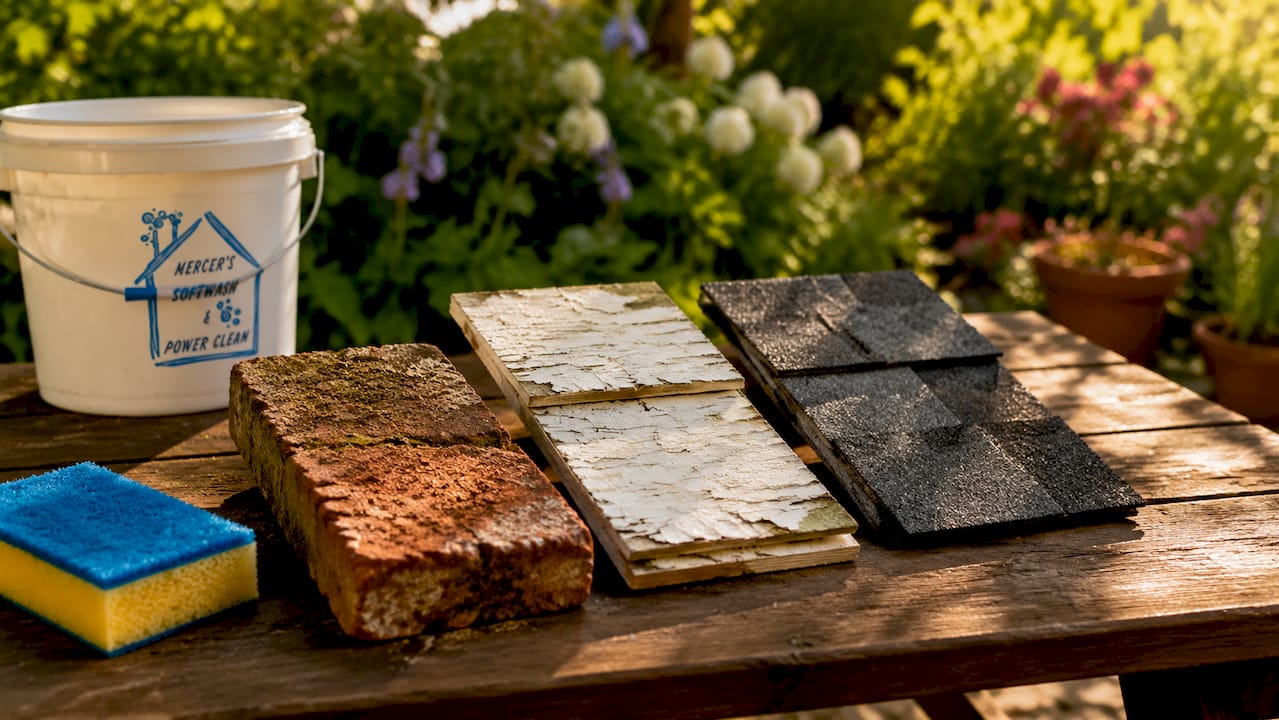
Chemical concentration also determines surface safety. Sodium hypochlorite concentration at the surface varies by material: 1–2% for vinyl and painted surfaces, 2–4% for stucco and brick, and 3–6% for roofs. The concentration applied at the surface, not the strength in the jug, is what determines both safety and cleaning efficacy. Getting this wrong causes surface damage or leaves biological growth behind.
Pro Tip: Any cleaning method using more than 500 PSI is not true soft washing. If a contractor claims to soft wash but uses high-pressure equipment, your surface and warranty are at risk.
2. Vinyl siding: the most common softwash safe material
Vinyl siding is the most widely cleaned exterior surface using soft washing across Southern Ontario. It expands and contracts with temperature changes, which makes it structurally vulnerable to high-pressure water forcing its way behind panels. Soft washing at 100–500 PSI cleans the surface thoroughly without driving water into the wall cavity.
Algae and mildew are the primary biological threats to vinyl siding. They cause the grey-green streaking that homeowners often mistake for dirt. Sodium hypochlorite at 1–2% concentration kills these organisms at the root rather than simply washing them off the surface. You can read more about vinyl siding care to understand how soft washing preserves the finish over time.
Soft washing also avoids the warping and cracking that high-pressure cleaning causes on older vinyl panels. This matters especially for properties built before 2000, where thinner vinyl profiles are more brittle. Preserving the panel integrity protects the insulation and vapour barrier behind the siding.
3. Stucco and EIFS: why pressure washing causes hidden damage
Stucco and Exterior Insulation and Finish Systems (EIFS) are among the surfaces most frequently damaged by pressure washing. Both materials are porous and applied in layers. High-pressure water penetrates the surface layer, saturates the substrate, and creates conditions for mould growth inside the wall system. Soft washing removes surface contamination without forcing water into the material.
EIFS is particularly sensitive because it consists of foam insulation covered by a thin synthetic finish coat. Any crack or breach in that finish coat allows water intrusion that is invisible from the outside. Soft washing at 2–4% sodium hypochlorite concentration cleans the surface and kills biological growth without the mechanical impact that creates those breaches.
Stucco homes in Southern Ontario are especially prone to algae growth due to seasonal moisture cycles. Treating the surface with a properly diluted soft wash solution and allowing adequate dwell time removes staining without the fracture risk that pressure washing creates.
4. Asphalt shingle roofs: protecting granules and warranties
Asphalt shingle roofs are the clearest example of a surface where pressure washing causes direct, measurable damage. The granules embedded in shingles protect the asphalt layer from UV degradation. Pressure washing blasts those granules off, shortening the roof’s lifespan significantly. Soft washing removes the black streaking caused by Gloeocapsa magma bacteria without touching the granule layer.
GAF, CertainTeed, and Owens Corning all recommend soft washing as the approved cleaning method for their shingle products. Using pressure washing on these roofs voids the manufacturer warranty. That warranty protection alone makes soft washing the only responsible choice for roof cleaning.
Sodium hypochlorite at 3–6% concentration is applied at low pressure and left to dwell on the shingle surface. This kills the bacteria and algae colonies that cause staining and biological deterioration. The result is a clean roof that retains its protective granule layer and its warranty coverage.
5. Painted wood siding and trim: can you softwash wood?
Painted wood siding and trim are safe for soft washing when the paint is in good condition and the wood is structurally sound. High-pressure washing strips paint from wood, raises the grain, and drives water into the fibres, which causes swelling, splitting, and rot. Soft washing cleans the painted surface without any of those outcomes.
The sodium hypochlorite solution at 1–2% concentration removes mildew, algae, and surface grime from painted wood without lifting the paint film. This is the key distinction: soft washing targets biological growth chemically, so the paint surface remains intact. Bare or weathered wood requires a different approach, as the chemical concentration must be carefully managed to avoid bleaching or drying the wood fibres.
Pro Tip: Always inspect painted wood for peeling or cracking before soft washing. Soft washing a surface with compromised paint will accelerate paint failure. Address paint repairs first, then clean.
Trim pieces around windows and doors are particularly well-suited to soft washing because they accumulate mildew in areas where a pressure washer cannot be safely directed. Soft washing reaches these areas with controlled chemical application and minimal pressure.
6. Fibre cement siding: maintaining Hardie board finish and structure
Fibre cement siding, most commonly known by the brand name James Hardie, is a dense, durable material that still benefits from soft washing over pressure washing. The factory-applied paint finish on Hardie board is designed to last, but high-pressure cleaning degrades that finish over time by creating micro-abrasions that allow moisture penetration.
Soft washing at 1–2% sodium hypochlorite removes algae and mildew from the textured surface without affecting the paint bond. Fibre cement is not porous in the same way as stucco, but the texture holds organic debris that feeds biological growth. Chemical treatment is more effective than mechanical force for clearing that growth from the surface profile.
James Hardie’s own maintenance guidelines recommend low-pressure washing for routine cleaning. Following those guidelines preserves both the appearance and the structural integrity of the panels, which is particularly relevant for property managers maintaining multiple units.
7. Soft washing versus pressure washing: lifespan and damage comparison
Soft washing kills biological growth at the root, producing results that last 4–6 times longer than pressure washing. Pressure washing removes surface-level contamination mechanically, but leaves the root system of algae and mould intact. Regrowth appears within weeks. Soft washing eliminates the organism entirely, so surfaces stay clean far longer.
| Factor | Soft washing | Pressure washing |
|---|---|---|
| Operating pressure | 100–500 PSI | 1,500–4,400 PSI |
| Cleaning method | Chemistry-first | Mechanical-first |
| Results duration | 4–6 times longer | Short-term surface clean |
| Warranty impact | Preserves manufacturer warranty | Can void warranty |
| Surface risk | Minimal on compatible surfaces | High on delicate materials |
“Soft washing is not simply low-pressure washing. It is a chemistry-first method where the cleaning solution does the work. The pressure is only used to apply and rinse the solution.” — Softwash Technologies
Pressure washing is mechanical-first cleaning that causes damage on delicate materials, whereas soft washing is chemistry-first and ideal for porous or painted surfaces. The practical implication for homeowners is straightforward: soft washing costs less in the long run because it does not damage surfaces and does not need to be repeated as frequently.
8. How to protect landscaping and pets during soft washing
Protecting landscaping during soft washing requires preparation before the cleaning begins. Pre-wetting surrounding vegetation saturates the soil and plant tissue, reducing the amount of sodium hypochlorite solution that plant roots can absorb. This step is not optional. Skipping it risks chemical scorch on grass, shrubs, and garden beds adjacent to the cleaned surface.
Surfactants play a role in protecting landscaping as well. Specialized surfactants cause the cleaning solution to adhere to vertical surfaces rather than sheeting off rapidly. This controlled application reduces the volume of runoff reaching the surrounding soil. Less runoff means less chemical exposure for plants and lawn.
Post-rinsing with clean water after soft washing dilutes any chemical residue that has reached the soil. Neutralising agents can be applied to the surrounding vegetation and ground to counteract chloride compounds before they cause damage. Pets should be kept indoors or away from the treated area during the wash and for at least one hour after rinsing is complete. Once the surface is dry and rinsed, the area is safe.
Pro Tip: Cover sensitive garden beds with plastic sheeting before soft washing begins. Pre-wet, wash, then remove the sheeting and rinse the plants thoroughly. This three-step approach gives your landscaping the best protection.
9. How often should you soft wash exterior surfaces?
Exterior surfaces should be washed at least once per year, with twice-yearly cleaning recommended for properties in coastal areas or regions with high pollen counts. Southern Ontario’s seasonal climate creates conditions where algae and mildew establish themselves quickly on north-facing and shaded surfaces. Waiting more than a year between cleanings allows biological growth to penetrate deeper into surface materials.
Knowing when your exterior needs cleaning before visible staining becomes severe saves you money on restoration. Black streaking on roofs, green tinting on siding, and grey discolouration on stucco are all signs that biological growth is already established. Catching these early means a single soft wash treatment resolves the issue. Waiting until the growth is heavy may require multiple applications or more intensive treatment.
The best time to wash your home’s exterior in Southern Ontario is late spring or early autumn, when temperatures are moderate and surfaces dry efficiently after treatment. Avoid soft washing in temperatures below 10°C, as sodium hypochlorite loses effectiveness in cold conditions and dwell time becomes unpredictable.
Key takeaways
Soft washing is the safest and most effective cleaning method for vinyl siding, stucco, asphalt shingle roofs, painted wood, and fibre cement siding because it removes biological growth at the root without mechanical damage.
| Point | Details |
|---|---|
| Safe surface types | Vinyl siding, stucco, asphalt shingles, painted wood, and fibre cement are all softwash compatible. |
| Pressure range matters | True soft washing operates at 100–500 PSI. Anything higher risks surface and warranty damage. |
| Chemical concentration varies | Sodium hypochlorite ranges from 1–2% for vinyl to 3–6% for roofs. Wrong concentration causes damage. |
| Results last longer | Soft washing kills growth at the root, producing results that last 4–6 times longer than pressure washing. |
| Landscaping protection is required | Pre-wet plants before washing and post-rinse with neutralisers to prevent chemical scorch. |
What I’ve learned from watching homeowners choose the wrong method
The most common mistake I see is homeowners renting a pressure washer and treating every surface the same way. A concrete driveway and an asphalt shingle roof are not the same surface, and they do not respond the same way to 3,000 PSI. The roof loses granules. The warranty disappears. The homeowner does not realise what happened until the shingles start failing years earlier than they should.
The second mistake is assuming that soft washing is just pressure washing with less pressure. It is not. The chemistry is doing the work. A contractor who applies a soft wash solution at the wrong concentration is either leaving biological growth behind or damaging the surface. Both outcomes are avoidable with proper calibration. This is why professional application matters more than the equipment itself.
What I find genuinely reassuring about soft washing done correctly is the longevity of the results. A properly treated vinyl siding or roof stays clean for a meaningful period because the organism causing the staining is dead, not just washed to the side. That is a fundamentally different outcome than what a pressure washer delivers. For property managers maintaining multiple buildings, that difference in cleaning frequency translates directly into reduced maintenance costs over time.
— Felix
Professional soft washing for Southern Ontario properties
Mercerssoftwashpowerclean works with homeowners and property managers across Southern Ontario to assess exterior surfaces and apply the correct soft washing treatment for each material. The team evaluates surface type, biological growth severity, and surrounding landscaping before selecting chemical concentrations and application methods. You can learn more about safe exterior cleaning and what the process involves for your specific property. Mercerssoftwashpowerclean also offers residential exterior services covering house washing, roof cleaning, deck and fence washing, and gutter cleaning, all performed with surface-appropriate methods that protect your investment.
FAQ
What surfaces should never be pressure washed?
Asphalt shingle roofs, vinyl siding, stucco, EIFS, and painted wood should not be pressure washed. These materials are damaged by the mechanical force of 1,500–4,400 PSI and are best cleaned with soft washing instead.
Can you softwash wood siding and trim?
Yes, painted wood siding and trim in good condition are safe for soft washing. The paint must be intact and the wood structurally sound before applying a 1–2% sodium hypochlorite solution at low pressure.
Does soft washing void roof warranties?
Soft washing preserves manufacturer warranties from brands like GAF, CertainTeed, and Owens Corning. Pressure washing voids these warranties by damaging the granule layer that protects the shingle.
How long do soft washing results last compared to pressure washing?
Soft washing results last 4–6 times longer than pressure washing because the cleaning solution kills biological growth at the root rather than removing only surface-level contamination.
Is soft washing safe for plants and gardens?
Soft washing is safe for landscaping when proper precautions are taken. Pre-wet all surrounding vegetation before washing, use surfactants to control runoff, and post-rinse with a neutralising agent to prevent chemical scorch on plants and grass.


