

Safe window cleaning in Canada comes down to five non-negotiable priorities: eliminate work at height wherever possible, follow CAN/CSA-Z91 and your provincial regulations, inspect anchors before every job, maintain a written rescue plan for any suspended access work, and document training and inspections. These are not suggestions — they are the baseline that regulators, insurers, and competent employers treat as the floor, not the ceiling.
Before you start any window cleaning task above ground level, run through this quick checklist:
- Eliminate first: Can you clean from the ground using a water-fed pole? If yes, do that instead.
- PPE minimum: Non-slip footwear, eye protection, and gloves for any job; a CSA-certified harness and shock-absorbing lanyard for any work above a certain height.
- Anchor check: Never use an anchor that has not been inspected by a competent person and documented in writing.
- Rescue plan: A written, practised rescue plan must exist before suspended access begins. You cannot improvise it after someone is suspended.
- Stop-work triggers: Gusty or wet conditions, damaged equipment, missing inspection records, or an anchor you cannot verify — stop work immediately.
TL;DR jobsite reminder: Eliminate the hazard. Inspect the anchors. Carry your rescue plan. Document everything. If in doubt, stop.
The Canadian Centre for Occupational Health and Safety (CCOHS) and provincial regulators such as WorkSafeBC and the Ontario Ministry of Labour enforce these requirements. Ontario’s Regulation 859 sets limits on fall arrest system performance to protect workers.
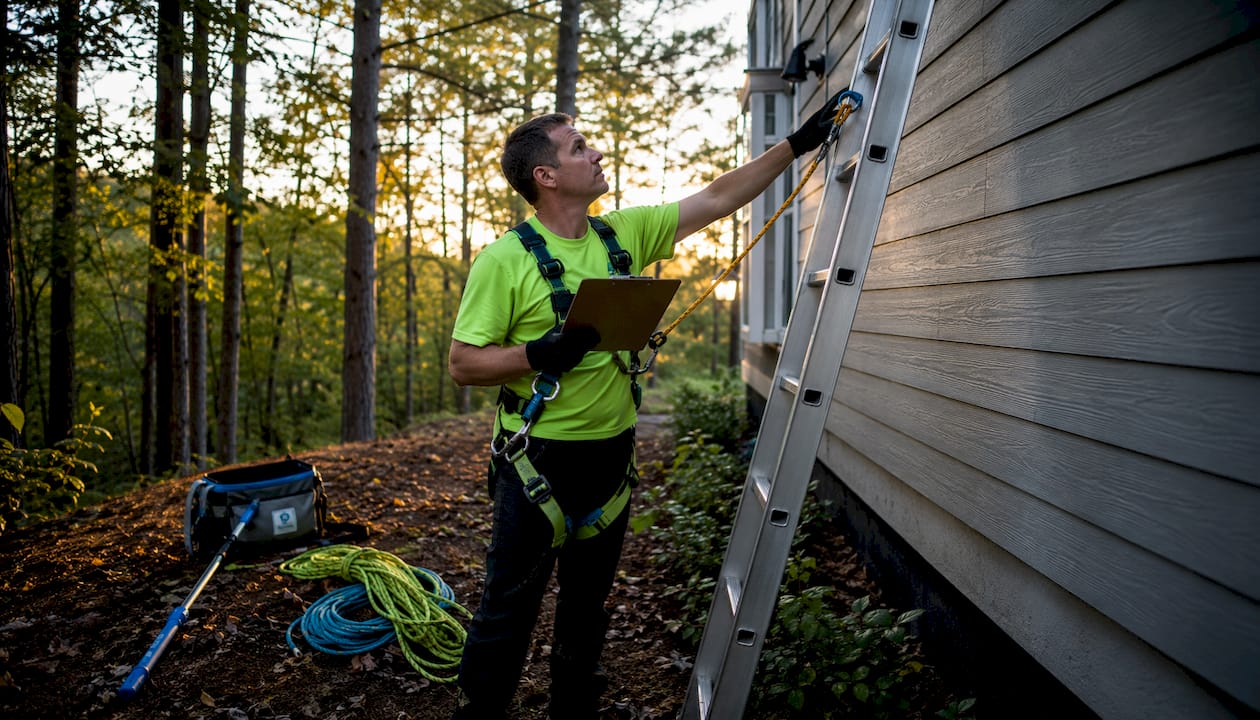
Why window cleaning safety matters across every job type
This guide covers window cleaning safety best practices for residential, commercial, and high-rise operations in Canada. Whether you are a homeowner on a stepladder or a crew supervisor managing a swing stage on a 20-storey building, the underlying principles are the same — the scale of consequence is what changes.
After reading this guide, you will be able to perform a site-specific job hazard analysis, select the right control method for your working height, verify PPE and anchor requirements, build a compliant rescue plan, and know when to call a certified specialist instead of proceeding yourself.
The guide addresses: site assessment, the hierarchy of controls, PPE and tool safety, ladder rules, suspended access and fall protection, rescue planning, equipment inspection, training and competency, setting-specific differences, and ground-based alternatives. It aligns throughout with CAN/CSA-Z91, Ontario Regulation 859, and provincial guidance from WorkSafeBC and the Ontario Ministry of Labour.
What Canadian regulations and employer responsibilities apply?
The primary authorities for window cleaning safety in Canada are CAN/CSA-Z91, Ontario Regulation 859, provincial workplace-safety regulators (WorkSafeBC in British Columbia, the Ontario Ministry of Labour in Ontario), and guidance from the Canadian Centre for Occupational Health and Safety (CCOHS). Federal buildings must comply with CAN/CSA-Z91 under the Canada Occupational Health and Safety Regulations; provincial buildings fall under the applicable provincial act and its window-cleaning regulation.
The table below summarises the critical regulatory thresholds and documentation requirements that directly affect how you plan and execute a job.
| Requirement | Threshold / Standard | Authority |
|---|---|---|
| Fall arrest free-fall limit | 1.5 m maximum | Reg. 859 (Ontario) |
| Peak arrest force limit | 8 kN maximum | Reg. 859 (Ontario) |
| Written work plan trigger | Work above specified height | Reg. 859 (Ontario) |
| Anchor inspection cadence | Before first use; regularly as recommended; after any reported defect | CAN/CSA-Z91 / SOR/86-304 |
| Inspection record retention | Records must be retained for a required period | CAN/CSA-Z91 / SOR/86-304 |
| Lifeline reuse after a fall | Prohibited — remove from service immediately | Reg. 859 (Ontario) |
| Competent-person inspection | Required before use of any anchor or suspended platform | Reg. 859 / CAN/CSA-Z91 |
For exterior cleaning compliance, understanding these thresholds is the starting point, not the finish line.
Employer responsibilities checklist:
- Prepare a written work plan for any suspended scaffold work above 3 m.
- Have a competent person inspect all anchor points and permanently installed suspended platforms before use and at least annually.
- Provide a documented training programme and verify each worker’s competency before they work at height.
- Retain inspection and maintenance records for a minimum of two years.
- Prepare sketches of all suitable anchor points on buildings where suspended scaffold equipment is used; building owners must keep these on file while systems are in use.
- Remove any fall arrest component from service immediately after it arrests a fall.
How to do a pre-job site assessment before any window cleaning
Perform a job hazard analysis before every job, without exception. If you cannot put adequate controls in place after completing the assessment, you do not start work. That is the rule, and it applies equally to a homeowner cleaning second-floor windows and a commercial crew setting up a swing stage.
Follow these steps in order:
-
Identify the work area and access routes. Walk the full perimeter. Note every point where a worker could reach a window, and every route to get there. Mark overhead hazards (power lines, HVAC units, overhangs).
-
Check anchor availability and condition. Locate all anchor points on the building. Confirm each has a current inspection record signed by a competent person. If records are missing or outdated, treat the anchor as unusable until re-inspected.
-
Assess pedestrian and vehicular risk. Identify areas below the work zone where falling tools, water, or equipment could strike people or vehicles. Plan exclusion zones with physical barriers or signage before work begins.
-
Evaluate weather conditions. Check the forecast for wind speed, precipitation, and temperature. Wind gusts above roughly 40 km/h are a common stop-work threshold for elevated work; wet surfaces increase slip risk at any height. For seasonal timing guidance, seasonal exterior cleaning considerations apply here too.
-
Confirm rescue access. Verify that emergency services can reach the work zone and that your rescue equipment is on site and functional before anyone goes up.
-
Select the control method. Based on the above, decide: ground-based water-fed pole, ladder, or suspended access. Document your decision and the reasoning.
Decision guide:
- Ground-based water-fed pole: use whenever the window is reachable from the ground and the glass type is compatible.
- Ladder: appropriate for low-rise residential work where the task is brief, the surface is stable, and the worker can maintain three points of contact throughout.
- Suspended access (swing stage, rope access, boatswain’s chair): required for high-rise or multi-storey commercial work; triggers the full written work plan, anchor inspection, and rescue plan requirements.
Slips and trips are consistently cited as a leading hazard for window cleaners, often caused by equipment left on walkways. Clearing the work zone of buckets, poles, and hoses before pedestrians re-enter the area is a basic but frequently skipped step.
How does the hierarchy of controls apply to window cleaning?
Elimination is the most effective control for window cleaning hazards, and water-fed pole systems are the clearest example of it in practice. When you remove the need to work at height entirely, you remove the fall risk — no harness, no anchor, no rescue plan required. The industry shift toward ground-based cleaning as a primary method reflects exactly this logic.
The table below maps each control level to practical window cleaning scenarios.
| Risk level / working height | Primary control | Required PPE and tools | Inspection and documentation | Training and rescue preparedness |
|---|---|---|---|---|
| Ground level / below 3 m (ground-based) | Elimination: water-fed pole from ground | Non-slip footwear, eye protection, gloves | Pre-use tool check; no anchor records required | Basic tool handling; no rescue plan required |
| Low-rise residential / 3 m or less (ladder) | Administrative / collective: stable ladder, spotter | Non-slip footwear, gloves, eye protection | Pre-use ladder inspection; log defects | Ladder safety training; basic first aid on site |
| Mid-rise commercial / above 3 m (not suspended) | Collective: guardrails, work platforms | Full PPE set; CSA-certified harness and lanyard | Written work plan; anchor inspection records | Fall protection training; rescue plan documented |
| High-rise / suspended access | Personal fall protection: lifeline, fall arrest | CSA-certified harness, shock-absorbing lanyard or SRL, helmet | Written work plan; competent-person anchor inspection; annual records | IRATA/SPRAT-level competency; written rescue plan; rescue drill records |
The key trade-off to understand: moving down the hierarchy from elimination toward personal protective equipment does not make a job safer — it adds layers of complexity, documentation, and human-error risk. Every time you can stay at ground level, you should.
What PPE and tools do you need for safe window cleaning?
PPE is the last line of defence, not the first. You select it after you have already applied every higher-level control available. That said, the right PPE set, properly fitted and inspected, is what stands between a worker and a serious injury when other controls are not enough.
PPE by task and height:
- Non-slip footwear: Required at every height. Wet surfaces and soapy runoff make standard footwear dangerous even at ground level.
- Eye protection: Safety glasses or goggles protect against cleaning solution splatter and debris dislodged from frames and sills.
- Gloves: Chemical-resistant gloves for any job involving cleaning solutions; cut-resistant gloves when using scrapers.
- Helmets: Required for any suspended access work and strongly recommended whenever there is overhead hazard risk.
- CSA-certified harness: Required for work above 3 m where fall protection is needed. The harness must be compatible with the lanyard and anchor system — mix-and-match components from different manufacturers can compromise the system’s rated performance.
- Shock-absorbing lanyard or self-retracting lifeline (SRL): The lanyard or SRL must keep free fall within the 1.5 m regulatory limit and must not transmit more than 8 kN of peak force to the worker.
Tool safety:
Scrapers, squeegees, and telescopic poles are the everyday tools of window cleaning, and each carries its own risk profile. Scrapers with exposed or chipped blades cause lacerations; always retract or cap blades when not in use. Squeegees on long poles shift the worker’s centre of gravity — keep your base wide and avoid overreaching. Water-fed poles can extend several metres; check ferrule connections and pole sections for cracks before each use.
Pro Tip: Tether every tool when working above ground. A dropped scraper or squeegee from even a second-storey window can cause a serious injury below. Use tool lanyards rated for the tool’s weight, and clip them to a dedicated tool-tethering point on your harness or belt, not to the fall arrest attachment.
For a detailed look at professional-grade tools and inspection routines, the equipment selection process matters as much as the PPE itself.
Ladder safety rules every window cleaner should follow
Ladders are appropriate for low-rise residential window cleaning where the task is brief, the surface is stable, and the worker does not need to reach beyond a safe, balanced position. They are not appropriate for sustained work at height, for carrying heavy equipment, or for any situation where three points of contact cannot be maintained throughout the task.
Before you set up:
- Inspect the ladder for cracked rails, broken or missing rungs, damaged feet, and loose hardware. A defective ladder does not go up.
- Confirm the load rating covers your weight plus tools and equipment. Most residential extension ladders are rated at 113 kg (250 lb) or 136 kg (300 lb) — know which you have.
- Check the ground surface. Soft, uneven, or wet ground requires a footing board or stabiliser. Never set a ladder on ice or freshly rained-on grass without securing the feet.
Setting up correctly:
- Use the 4:1 angle rule: for every 4 metres of vertical height, the base should be 1 metre out from the wall.
- Extend the ladder at least 1 metre above the landing point if you are stepping off at the top.
- Tie off the top of the ladder to a fixed anchor point whenever possible, particularly for extension ladders on smooth surfaces.
While on the ladder:
- Maintain three points of contact at all times: two hands and one foot, or two feet and one hand.
- Keep your hips between the rails. Leaning outside the rails shifts your weight beyond the ladder’s stable zone.
- Never carry a bucket or large tool in your hand while climbing. Use a tool belt or a bucket hook rated for the load.
Stop work immediately if:
- A rung or rail is cracked, bent, or missing.
- The ladder rocks or shifts after setup.
- Wind or rain has made the surface or rungs slippery.
- You need to reach a window that requires leaning past the rail to access it.
For related guidance on working safely at household heights, gutter cleaning safety tips cover many of the same ladder principles in a residential context.
What do suspended access systems require for high-rise window cleaning?
Suspended access work requires a documented work plan, certified equipment, and a written rescue plan in place before anyone leaves the ground. This is not optional — Regulation 859 and CAN/CSA-Z91 both make these requirements explicit for any suspended scaffold operation.
Equipment types and key safety attributes:
Swing stages (suspended scaffolds): The most common platform for commercial high-rise work. They must have redundant suspension lines, rated outriggers, and guardrails on all open sides. Each suspension line is independent so that a single-point failure does not cause a platform collapse.
Boatswain’s chairs: Single-worker suspended seats used for lighter tasks on smaller buildings. They require the same anchor inspection and rescue plan as a full swing stage, despite their simpler appearance. One worker per lifeline is the standard; sharing a lifeline between workers is not permitted.
Rope access: Used by trained technicians for complex facades where platforms are impractical. IRATA (Industrial Rope Access Trade Association) and SPRAT (Society of Professional Rope Access Technicians) certification is recognised by Ontario inspectors as evidence of competency. Rope access systems require two independent lines per worker: a working line and a separate safety line.
Anchor inspection and recordkeeping:
Anchor points are a frequent single point of failure. Treat anchor verification as an engineering exercise, not a visual check. Under CAN/CSA-Z91 and federal regulations, anchor points must be inspected by a qualified person before first use, at least annually, and whenever a defect is reported. The inspector must produce a written, signed, and dated report immediately after the inspection. Records must be kept for a minimum of two years, and modification or repair records must be kept for as long as the system is in use.
Refuse to use any anchor that lacks a current inspection record, shows visible corrosion or deformation, or has been flagged in a previous report and not repaired. For rooftop access and anchor coordination, a roof inspection checklist can help identify structural concerns before the window cleaning crew arrives.
What must a rescue plan include for suspended access work?
A written, practised rescue plan is mandatory for suspended access work and cannot be improvised at the time of an incident. If someone is suspended and unable to self-rescue, the window between suspension and serious injury or death is short — typically under 15 minutes before suspension trauma becomes a medical emergency.
Build your rescue plan using these steps:
-
Assign roles before work begins. Designate a rescue coordinator, a ground-level spotter, and a backup communicator. Every person on site must know their role before anyone goes up.
-
Confirm on-site rescue equipment. A rescue kit must be physically present at the work site. Minimum contents: a lowering device compatible with the suspension system, a rescue line, a first aid kit, and a means of communication (radio or phone with confirmed signal).
-
Establish communication protocols. Agree on check-in intervals (every 15–30 minutes is common for high-rise work). Define the signal or phrase that triggers a rescue response so there is no ambiguity.
-
Contact external emergency services in advance. Know the address of the building, the floor and face where work is occurring, and the nearest emergency access point. Pre-call the local fire department if the building’s height or configuration makes self-rescue impossible — some jurisdictions expect this for high-rise work.
-
Conduct a rescue drill. A plan that has never been practised is a plan that will fail under pressure. Run a drill before the first day of work on any new site.
-
Document the plan and the drill. Keep a written copy of the rescue plan on site. Log the drill date, participants, and any corrective actions identified.
Essential rescue equipment and records to maintain:
- Lowering device (rated and compatible with the suspension system in use)
- Rescue line and anchor attachment
- First aid kit with trauma supplies
- Communication device with confirmed signal at height
- Training logs showing each worker’s rescue training date and competency verification
- Drill records with dates, participants, and outcomes
How often should you inspect window-cleaning equipment?
Equipment inspection is both a legal requirement and the most direct way to prevent equipment failure during a job. Skipping inspections does not save time — it creates liability, voids equipment warranties, and puts workers at risk of a fall from a component that looked fine but was not.
Inspection schedules:
Pre-use checks (every use): Visually inspect harnesses for frayed webbing, damaged buckles, and stitching integrity. Check lanyards and SRLs for cuts, kinks, and connector function. Inspect lifelines for abrasion, core damage, and termination condition. Confirm that all connectors are locked and that no component has been involved in a fall since its last inspection.
Daily and weekly visual checks: Inspect platforms, outriggers, and suspension lines for wear, corrosion, and mechanical damage. Check wire ropes for broken strands, kinks, and corrosion. Inspect mechanical winches for proper function, brake engagement, and lubrication.
Annual third-party inspections: Anchors and permanently installed suspended platforms require inspection at least annually by a competent person, with a written, signed, and dated report. CAN/CSA Z271 recommends testing post-installed fasteners after installation and at intervals not exceeding five years.
Recordkeeping checklist:
- Harness inspection log: date, inspector name, condition notes, pass/fail
- Lifeline and lanyard log: same fields, plus notation if removed from service after a fall
- Anchor inspection report: signed and dated, retained for minimum 2 years
- Platform and winch maintenance log: service dates, parts replaced, technician name
- Modification and repair records: retained for as long as the system is in use
A component removed from service after arresting a fall must be logged as retired and physically segregated from serviceable equipment. Colour-tagging retired equipment is a practical way to prevent accidental reuse.
What training and competency do window-cleaning workers need?
The expectation under the Ontario Occupational Health and Safety Act and equivalent provincial legislation is documented, effective training and verified competency before a worker performs any window cleaning at height. Ontario guidance is explicit: employers relying on in-house training must demonstrate that their procedures meet the duty to take every reasonable precaution, which in practice means showing how their training maps to recognised standards such as IRATA or SPRAT competencies.
Training topics that must be covered:
- Fall protection principles and the hierarchy of controls
- Correct selection, fitting, and inspection of harnesses, lanyards, and SRLs
- Rigging and anchor assessment
- Descent control and emergency descent procedures
- Rescue techniques and use of rescue equipment
- Equipment care, pre-use inspection, and retirement criteria
- Weather assessment and stop-work decision-making
- Communication protocols for suspended access work
What to keep on file:
- Training completion records with dates, topics covered, and trainer credentials
- Competency verification records (written test, practical assessment, or third-party certification)
- IRATA or SPRAT certificates where applicable
- Refresher training records (annual refresher is the common expectation for fall protection)
Supervision and refresher intervals:
New workers should not perform suspended access work without direct supervision from a competent, experienced worker until their competency is formally verified. Refresher training at least annually keeps skills current and satisfies most inspector expectations. When demonstrating competency to an inspector, the clearest evidence is a combination of third-party certification, training logs, and a site-specific work plan that shows the worker understands the specific hazards of the building they are working on.
How do safety practices differ for residential, commercial, and high-rise work?
The core principles of safe window cleaning do not change between settings, but the scale of risk, the regulatory triggers, and the required controls differ significantly. Understanding those differences lets you apply the right level of rigour without over-engineering a simple residential job or under-preparing for a complex commercial one.
Residential: Most residential window cleaning involves low-rise work where ladders or ground-based water-fed poles are sufficient. The main risks are ladder misuse, slippery surfaces, and tool drops. A written work plan is not typically required for work under 3 m, but a pre-job hazard check, proper ladder setup, and appropriate PPE are still expected. Homeowners attempting second-storey windows should seriously consider whether a ground-based method or a professional service is the safer choice.
Commercial (low-to-mid-rise): Storefront and low-rise commercial work introduces public exclusion zones, pedestrian traffic management, and the need to coordinate with property managers. Canopies, signage, and irregular facades create anchor and access challenges. A site-specific risk assessment is standard practice, and any work above 3 m requires a written work plan. For guidance on managing pedestrian risk around commercial facades, commercial awning cleaning procedures offer a useful parallel.
High-rise: High-rise window cleaning triggers the full suite of requirements: engineered anchors, documented work plans, CSA-certified suspended access equipment, written rescue plans, and IRATA/SPRAT-level competency. Public exclusion zones must be physically enforced, not just marked. Communication between the suspended crew and the ground team must be continuous. For commercial window cleaning at this scale, the difference between a compliant and a non-compliant operation is almost always in the documentation and the anchor verification, not the cleaning technique itself.
Common mistakes that should stop window cleaning work immediately
The leading causes of window cleaning incidents are anchor failure, slips and trips, working in unsafe weather, and inadequate or absent rescue provisions. Most of these incidents are preceded by a small, visible warning sign that was ignored or rationalised away.
Routine mistakes to watch for:
- Using an anchor without a current inspection record or visible damage assessment.
- Reusing a fall arrest harness, lanyard, or lifeline after it has arrested a fall. These components must be retired immediately.
- Setting up a ladder on soft, uneven, or wet ground without securing the feet.
- Working in wind gusts that make the platform or ladder unstable, or in rain that makes surfaces slippery.
- Leaving ladders, buckets, or poles in pedestrian pathways without barriers or signage.
- Failing to establish an exclusion zone below the work area before starting.
- Starting suspended access work without a written rescue plan and rescue equipment physically on site.
- Allowing a worker to proceed without verified training records on file.
Small mistakes escalate quickly at height. A worker who overreaches on a ladder to avoid repositioning it shifts their centre of gravity past the safe zone in a fraction of a second. An anchor that “looked fine” but had not been formally inspected in three years can fail under dynamic load. The pattern in most incidents is not a single catastrophic failure — it is a sequence of small shortcuts that individually seemed acceptable.
If any item on the list above is present when you arrive on site, stop work. Correct the condition before proceeding. That decision is always the right one.
When do water-fed poles replace working at height?
Removing the need to work at height is the single most effective safety measure available in window cleaning, and water-fed pole systems are the most practical way to achieve it for a wide range of jobs. When a water-fed pole can reach the window from the ground, the fall risk disappears entirely — no harness, no anchor inspection, no rescue plan required.
The operational benefits extend beyond safety. Ground-based cleaning is typically faster to set up, requires less PPE, and reduces the administrative burden of documented inspections and work plans. For residential and low-to-mid-rise commercial work, water-fed poles with purified water (reverse osmosis or deionised) leave glass streak-free without the need for squeegee finishing, which further reduces the time a worker spends repositioning.
Practical limits to know:
- Height reach: most professional water-fed pole systems reach 12–15 metres from the ground, covering roughly four to five storeys. Beyond that, suspended access is typically required.
- Glass type: some heritage glass, leaded glass, and certain coated or filmed glass types require careful assessment before using a water-fed pole. For buildings with specialised glazing, checking with a solar film for windows specialist before cleaning can prevent damage to coatings.
- Access and obstruction: planters, canopies, parked vehicles, and irregular facades can limit pole angle and reach. A site walk before setup identifies these constraints.
Pro Tip: Water quality matters as much as reach. Purified water with a total dissolved solids (TDS) reading below 10 parts per million (ppm) is the standard for spot-free results. Use a TDS meter to verify your water quality before starting — high TDS water will leave mineral deposits on the glass regardless of technique.
When windows are beyond pole reach or the facade requires closer inspection, that is the point to bring in a specialist with the right suspended access credentials, not to improvise a ladder solution.
Key takeaways
Safe, compliant window cleaning in Canada requires eliminating work at height wherever possible, verifying anchors and rescue plans before every suspended access job, and maintaining documented training and inspection records throughout.
| Point | Details |
|---|---|
| Eliminate height hazards first | Use water-fed poles from the ground whenever the window is within reach — no anchor or rescue plan required. |
| Know the regulatory triggers | Ontario Reg. 859 requires a written work plan for any work above 3 m; fall arrest must limit free fall to 1.5 m and peak force to 8 kN. |
| Inspect and document anchors | Anchors must be inspected by a competent person before use and at least annually; records kept for a minimum of 2 years. |
| Rescue plan before suspended access | A written, practised rescue plan with on-site equipment must exist before anyone uses a swing stage, boatswain’s chair, or rope access system. |
| Mercerssoftwashpowerclean | Provides documented site assessments, trained crews, and compliant window cleaning for residential and commercial properties across Southern Ontario. |
The part of window cleaning safety most people get wrong
The conventional wisdom on window cleaning safety focuses heavily on PPE — get the right harness, use the right lanyard, and you are covered. That framing is understandable, but it puts the emphasis at the wrong end of the hierarchy of controls.
The more important question is always: why are we working at height at all? In a significant number of residential and low-to-mid-rise commercial jobs, the answer is habit or assumption, not necessity. Water-fed poles have made ground-based cleaning viable for buildings that crews were routinely accessing by ladder or swing stage a decade ago. The safety gain from eliminating height work is categorically larger than any improvement you can make to your harness selection.
The second thing that gets underestimated is the anchor. Crews spend considerable time selecting and fitting PPE, and almost no time verifying that the anchor the harness is clipped to has been formally inspected. An uninspected anchor is not a safety system — it is a false sense of security. The inspection record is the safety system. The anchor is only as trustworthy as the last signed report.
The third gap is rescue planning. Most window cleaning operations have a rescue plan in name only: a vague understanding that someone would call 911. A real rescue plan names roles, specifies equipment, and has been practised. The difference between those two things is the difference between a recoverable incident and a fatality.
Mercer’s Softwash & Power Clean: safe, insured exterior cleaning in Southern Ontario
When a job involves heights, anchors, or suspended access, the right move is hiring a provider with documented safety credentials, not figuring it out on the fly. Mercerssoftwashpowerclean delivers professional window cleaning and exterior cleaning services across Southern Ontario with site-specific risk assessments, trained crews, and the documentation that regulators and property managers expect.
For residential clients, Mercerssoftwashpowerclean prioritises ground-based methods wherever possible, reducing risk and protecting surfaces. For commercial properties, the team brings the inspection records, written work plans, and PPE compliance that a responsible property manager needs on file. The same rigour that applies to window cleaning extends across the full range of residential services, from soft washing and roof cleaning to gutter cleaning and graffiti removal.
To request a quote or ask about safety documentation for your property, visit the window cleaning service page and get in touch directly.
Useful sources and authoritative references
These are the primary official sources to consult for compliance verification and deeper regulatory detail. Always check the current version of any regulation, as amendments may have occurred since this guide was written.
-
CAN/CSA-Z91 via Canada Occupational Health and Safety Regulations (SOR/86-304): The federal standard governing window cleaning operations in Canada, including anchor inspection requirements, inspection cadence, and recordkeeping obligations. Applies to federally regulated buildings; referenced by provincial standards as the baseline.
-
R.R.O. 1990, Reg. 859 — Window Cleaning (Ontario): Ontario’s specific regulation for window cleaning operations. Sets the 3 m written work plan trigger, the 1.5 m free-fall limit, the 8 kN peak force limit, and building owner responsibilities for anchor sketches and inspections.
-
Achieve compliance in window cleaning operations (Ontario Ministry of Labour): Practical compliance guidance explaining how IRATA and SPRAT certification satisfies the OHSA duty to take every reasonable precaution for rope access work.
-
Access and fall protection in window cleaning (Ontario): Detailed guidance on lifelines, fall arrest components, exclusion zones, and inspection intervals including CAN/CSA Z271 testing requirements for post-installed fasteners.
-
Canadian Centre for Occupational Health and Safety (CCOHS) — ccohs.ca: National resource for occupational health and safety guidance, including hazard identification, PPE selection, and workplace safety programme development. Consult for general fall protection and hazard assessment resources.
-
WorkSafeBC — worksafebc.com: British Columbia’s provincial workplace safety regulator. Publishes regulations, inspection bulletins, and guidance specific to BC window cleaning and working-at-height operations.


