

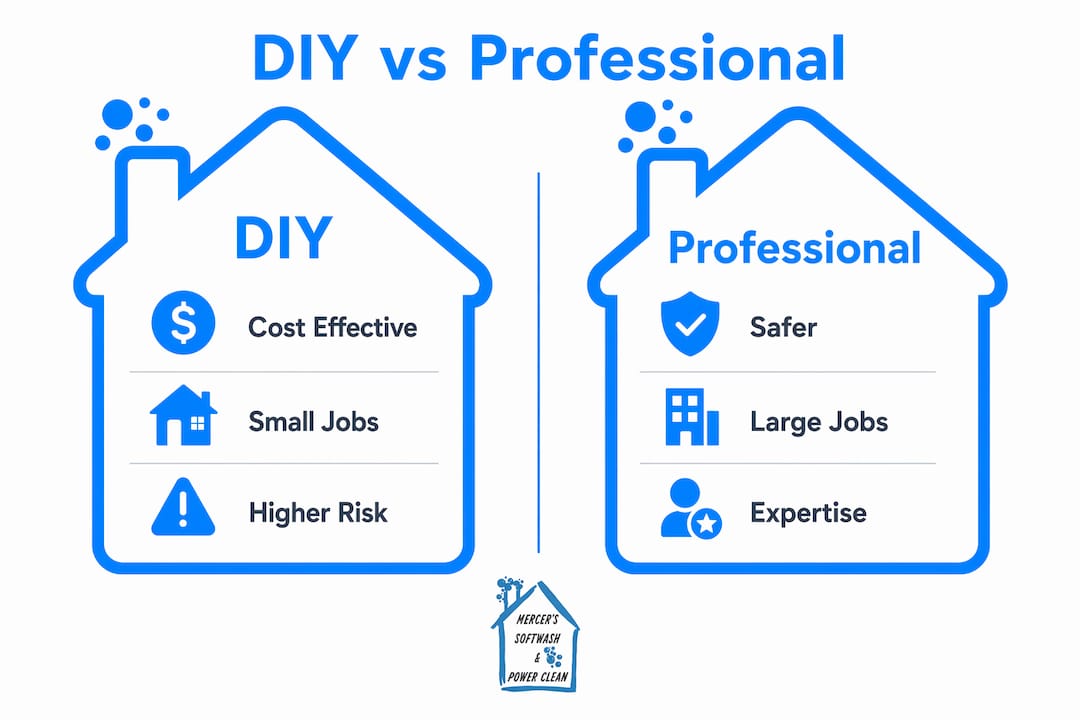
Hire a professional for any exterior cleaning job that involves roofs, multi-storey siding, heavy biological growth, or warranty-sensitive materials. DIY is reasonable for small, low-risk surfaces like a single-level concrete patio, outdoor furniture, or a compact ground-level deck with no delicate finishes.
Three reasons drive that verdict:
- Equipment and chemistry: Commercial rigs run higher GPM (gallons per minute) and carry proportioning systems, full nozzle sets, and dedicated low-pressure soft-wash pumps that consumer or rental units simply do not include. That gap in capability is where most DIY damage starts.
- Technique over PSI: Operator technique — nozzle selection, working distance, and angle — determines the actual pressure reaching a surface far more than the number printed on the machine. Without training, that variable is uncontrolled.
- Risk management: Licensed professionals carry liability insurance, conduct pre-job assessments, and provide written service agreements. If something goes wrong on a DIY job, the repair bill and any liability fall entirely on you.
Read the comparison table in the next section to map your specific property and task to the right approach.
How does professional washing differ from DIY? A side-by-side comparison
The table below covers the eight decision axes that matter most for Canadian homeowners and property managers.
| Factor | DIY washing | Professional washing |
|---|---|---|
| Best for (task/scale) | Small concrete pads, outdoor furniture, single-level low-risk decks | Multi-storey homes, roofs, siding, large commercial properties, heavy biological growth |
| Equipment & technique | Consumer or rental units (up to 4,000 PSI, limited nozzles, no proportioner) | Commercial-grade machines, proportioning systems, full nozzle sets, dedicated soft-wash rigs |
| Result durability | Shorter — surface staining returns faster without chemical treatment | Longer-lasting; soft washing kills organisms at the root, slowing regrowth significantly |
| Risk of surface damage | High on delicate surfaces; water intrusion, granule loss, stripped paint common | Low when matched to surface; pros test patches and adjust in real time |
| Time & homeowner effort | Full weekend or more for a whole home; steep learning curve | A few hours; no homeowner involvement during the job |
| Typical Canadian cost range varies by region and job specifics. | Rental + chemicals + PPE: —; hidden repair costs possible | House wash: —; roof soft wash: —; driveway: — |
| Environmental/chemical use | Off-the-shelf products; variable environmental impact; runoff often uncontrolled | Biodegradable, industry-approved solutions; containment of runoff standard practice |
| Warranty/insurance | High-pressure DIY can void siding and roofing manufacturer warranties | Soft washing protects roofing warranties; pros carry liability insurance |
The highest-risk mismatches to avoid:
Pressure washing a roof is the single most consequential DIY mistake. High-pressure water strips protective granules from asphalt shingles, accelerates wear, and can void the manufacturer’s warranty outright. Similarly, mixing your own soft-wash solutions without proper training risks chemical burns, plant damage, and incorrect dilutions that either harm surfaces or fail to kill the biological growth you are targeting.
Pro Tip: Nozzle angle matters as much as pressure. A 15-degree nozzle held six inches from vinyl siding delivers a very different effective pressure than the same nozzle held 18 inches away. Professionals adjust both distance and angle continuously; most homeowners hold the wand at a fixed distance and wonder why results are uneven.
What methods and equipment do professionals actually use?
Understanding the mechanics behind each method makes the cost and risk trade-offs much clearer.
Soft washing vs pressure washing: the core distinction
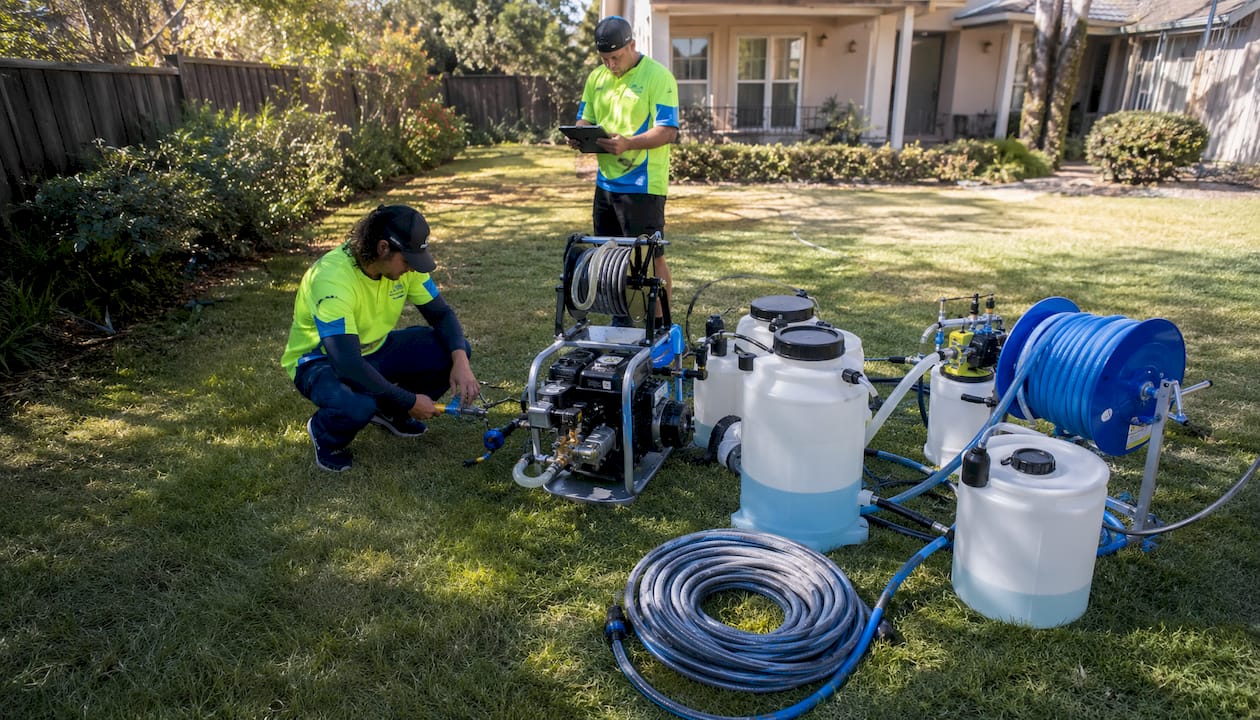
Soft washing uses low water pressure — comparable to a garden hose — combined with specialised cleaning solutions that dwell on the surface and break down biological growth at a chemical level. The active agents typically include Sodium Hypochlorite (a controlled bleach solution), surfactants to help the solution cling and penetrate, and neutralisers applied after the dwell period. Because the chemistry does the work rather than mechanical force, soft washing produces longer-lasting results against algae, moss, lichen, and mildew.
Pressure washing, by contrast, relies on mechanical force — typically 1,500 to 4,000+ PSI — to blast away dirt, stains, and loose debris. It is the right tool for hard, durable surfaces like concrete driveways, brick, and patio stone. It is the wrong tool for asphalt shingles, vinyl siding, painted wood, or any surface where forced water intrusion is a concern.
What commercial equipment includes that consumer units do not
Professionals arrive with a significantly different toolkit than anything available at a hardware store or rental counter:
- Proportioning systems: These inject cleaning solution at precise ratios automatically, ensuring consistent chemical concentration across the entire job. Consumer units require manual mixing, which leads to over- or under-concentration.
- Dedicated low-pressure soft-wash pumps: Separate from the high-pressure unit, these deliver solution at very low PSI with high volume, which is essential for roof and siding applications.
- Higher GPM output: Commercial machines move more water per minute than consumer units, which translates to faster, more thorough rinsing and better surface coverage.
- Full nozzle sets: Pros carry 0-degree, 15-degree, 25-degree, 40-degree, and soap nozzles, plus surface cleaners, extension wands, and gutter attachments. A rental unit typically comes with two or three tips.
- PPE and containment: Safety glasses, steel-toed boots, hearing protection, chemical-resistant gloves, and runoff containment equipment are standard on professional jobs.
You can read more about low-pressure washing systems and why they are the safer choice for most residential surfaces.
Why GPM matters more than PSI for most jobs
PSI measures the force of the water; GPM measures the volume. A machine with high PSI but low GPM can score the surface of concrete without actually cleaning it efficiently. Professionals select their equipment based on the combination of both, then fine-tune with nozzle choice and working distance. The “more pressure equals better cleaning” assumption is one of the most persistent misconceptions in exterior cleaning, and it is the direct cause of a significant share of DIY surface damage.
What hidden risks do homeowners underestimate with DIY washing?
The upfront savings of renting a pressure washer can look attractive. The costs that follow are less visible — and often far larger.
Water intrusion behind siding
DIY pressure washing commonly forces water behind siding panels and into wall cavities. The damage — wood rot, mould growth, and compromised insulation — typically does not appear for weeks or months after the wash. By the time a homeowner notices discolouration, soft spots, or a musty smell, the remediation cost has grown well beyond what a professional cleaning would have cost. This is the delayed-damage pattern that professionals encounter repeatedly on re-inspection calls.
Roof shingle damage and voided warranties
High-pressure washing strips the protective granule layer from asphalt shingles. Those granules are not cosmetic; they protect the underlying mat from UV degradation and extend the shingle’s rated lifespan. Roofing manufacturers commonly specify low-pressure chemical cleaning as the only acceptable maintenance method, meaning a single DIY pressure wash can void a warranty that still has years left on it. Professional roof soft washing avoids this entirely by using chemistry rather than force.
Safety and liability risks
Falls from ladders account for a disproportionate share of home-improvement injuries in Canada. Pressure washing from a ladder compounds the risk: the recoil from a high-pressure wand affects balance, and wet surfaces underfoot reduce grip. Beyond falls, directing a high-pressure stream near electrical panels, outdoor outlets, or light fixtures creates a genuine electrocution hazard. If a homeowner is injured or causes property damage during a DIY wash, their standard home insurance policy may not cover the claim, particularly if the work involved heights or chemical application.
Pro Tip: Before any exterior wash — DIY or professional — walk the perimeter and note any existing gaps in caulking, loose siding panels, or cracked mortar. These are the entry points where water intrusion is most likely. A professional will flag these during a pre-inspection; if you are doing a small job yourself, seal them first.
The same principle applies to other home improvement projects where DIY shortcuts create delayed, expensive consequences. Common DIY pitfalls across home services tend to follow a similar pattern: the visible task looks straightforward, and the hidden complexity only reveals itself after the fact.
What should Canadian homeowners expect to pay, and how often?
Cost and frequency are the two questions most homeowners ask first. Both depend on surface type, property size, contamination level, and access.
What drives the cost of professional washing
Several factors push the price of a professional exterior cleaning job up or down:
- Surface area and height (multi-storey homes require scaffolding or extended ladders, adding time and equipment cost)
- Level of biological contamination (heavy algae or lichen requires longer dwell times and sometimes multiple applications)
- Travel and disposal (rural properties or jobs requiring chemical disposal add to the total)
- Method required (soft wash chemistry costs more per litre than plain water, but produces better results on biological growth)
DIY costs appear lower upfront, but rentals, chemicals, PPE, and time investment often close the gap with professional pricing — and that calculation does not include the cost of repairing damage.
Typical Canadian cost range varies by region and job specifics and time estimates
| Job | Typical Canadian cost range varies by region and job specifics. | Estimated job time |
|---|---|---|
| Driveway / concrete cleaning | Cost varies by provider | 1–2 hours |
| House wash (siding, single-storey) | Cost varies by provider | 2–4 hours |
| House wash (two-storey) | Cost varies by provider | 3–5 hours |
| Roof soft wash | Cost varies by provider | 2–4 hours |
| Deck or fence washing | Cost varies by provider | 1–3 hours |
| Gutter cleaning | Cost varies by provider | 1–2 hours |
Prices vary significantly by region and urban labour costs.
Recommended cleaning frequency by surface type depends on material, exposure, and climate conditions. Roofs and siding typically require periodic cleaning every few years, while driveways, decks, fences, and gutters benefit from regular maintenance at appropriate intervals.
A note on environmental considerations: Many Canadian municipalities have bylaws governing chemical runoff into storm drains. Professional companies are familiar with these regulations and use containment measures accordingly. If you are washing a surface near a drain, waterway, or garden, check your local municipal guidelines before applying any cleaning solution. When it comes to specialised surfaces like coated garage floors, the chemicals safe for coated concrete differ significantly from standard pressure-washing detergents.
When is DIY washing reasonable? A safe approach for low-risk jobs
Some jobs genuinely are appropriate for a careful homeowner with basic equipment. The key is knowing exactly where that boundary sits.
Appropriate DIY situations:
- Small concrete areas: a single-car driveway apron, a front walkway, or a ground-level patio with no delicate finishes
- Outdoor furniture: plastic, metal, or resin furniture that can handle direct water contact
- A single-level deck with no painted or stained finish that you plan to refinish anyway
Step-by-step safety checklist for a low-risk DIY wash:
- Put on PPE first. Safety glasses, waterproof gloves, and closed-toe footwear are the minimum. Add hearing protection if using a gas-powered unit.
- Do a test patch. Choose an inconspicuous area and test your nozzle, distance, and pressure before committing to the full surface. Wait two minutes and inspect for damage.
- Select the right nozzle. For concrete, a 25-degree tip at 12–18 inches is a reasonable starting point. Never use a 0-degree (red) tip on any residential surface.
- Work top to bottom. Dirty water runs downward; always clean from the highest point to the lowest to avoid re-contaminating already-cleaned areas.
- Protect plants and drains. Wet down surrounding vegetation before you start and rinse it again after. Cover nearby drains if you are using any cleaning solution.
- Keep the wand moving. Holding the stream in one spot concentrates pressure and can etch or score the surface.
Do not do these things:
- Do not pressure wash your roof under any circumstances. The granule loss and warranty risk are not worth it.
- Do not use bleach-based solutions near vegetation, painted surfaces, or metal fixtures without understanding the dilution and neutralisation steps.
- Do not force water upward behind siding, window frames, or trim. Always direct the stream downward at an angle.
- Do not work from a ladder with a pressure washer. The recoil and wet conditions make this genuinely dangerous.
- Do not assume a rental unit is safe because it is available to the public. Consumer and rental units can reach 4,000 PSI — enough to cause serious surface damage and injury.
For a detailed walkthrough of deck washing specifically, the guide on how to pressure wash a wood deck safely covers nozzle selection, distance, and grain direction in practical terms.
How do you choose a reputable exterior cleaning professional?
Not every company that owns a pressure washer is qualified to clean your home. Knowing what to ask on the first call separates competent professionals from risky providers.
Questions to ask before booking
- Are you insured? Ask specifically for general liability insurance and confirm the coverage amount. A reputable company will provide a certificate of insurance without hesitation.
- Do you provide a written estimate? The estimate should itemise what is included, what chemicals will be used, and what the re-clean or guarantee policy is.
- What method will you use on my roof or siding? The correct answer for roofs and vinyl siding is soft washing. Any company that proposes high-pressure washing on these surfaces is a red flag.
- What cleaning solutions do you use, and how do you handle runoff? Professionals should be able to name their products and describe their containment approach.
- Can you provide references or show a portfolio? Before-and-after photos and verifiable online reviews are the clearest evidence of consistent results.
- What is your re-clean policy if I am not satisfied? A written guarantee or re-clean commitment is a standard trust signal from established companies.
Trust signals to look for
Liability insurance and worker training are the two non-negotiable signals. Beyond those, look for a written service agreement that specifies the scope of work, a photo gallery of completed jobs, and a track record of online reviews that mention specific surfaces and results rather than generic praise. Professional pre-inspections and documented service agreements are the hallmarks of a company that takes liability seriously.
Red flags: An unusually low bid with no written breakdown, vague answers about chemicals, or a refusal to provide insurance documentation are all reasons to look elsewhere. The cheapest quote often reflects the absence of insurance, proper equipment, or trained operators — costs that transfer to you if something goes wrong.
What happens on the day? What to expect when you hire a professional
Knowing what a professional job looks like from start to finish helps you prepare and ensures you get full value from the service.
Typical job timeline
For a standard house wash on a single-storey home, expect the following sequence: an initial estimate visit (30–60 minutes), followed by the cleaning appointment itself (2–4 hours), and a final walkthrough before the crew leaves. Roof soft washing on a typical bungalow runs 2–4 hours. A driveway cleaning is usually complete within 1–2 hours.
Homeowner preparation checklist
Before the crew arrives, take care of the following:
- Move vehicles out of the driveway and away from the work area
- Secure or bring indoors any pets
- Cover or move potted plants and delicate garden features near the house
- Remove personal items, cushions, and breakables from the exterior work area
- Close all windows and doors, and ensure they are properly sealed
What happens on site
The crew will begin with a pre-inspection, walking the perimeter to identify any existing damage, gaps in caulking, or areas requiring special attention. Test patches are applied on less visible sections before full application begins. Runoff containment is set up where required. Cleaning solution is applied and allowed to dwell — this is the step that distinguishes soft washing from a simple rinse. After the dwell period, the surface is rinsed thoroughly and inspected for missed areas. A final walkthrough with the homeowner confirms the result before the crew packs up.
Re-entry timing and aftercare
For soft-washed surfaces, you can generally walk on treated concrete within 30–60 minutes once the surface is dry. Siding and roofs require no special re-entry precautions. For decks that have been washed in preparation for staining or sealing, allow the wood to dry fully — typically 48–72 hours in warm weather — before applying any finish. Simple aftercare for siding includes reviewing the guidance on protecting siding after soft washing to extend the time between service visits.
Key takeaways
Professional exterior washing consistently outperforms DIY on durability, safety, and long-term cost when the job involves roofs, multi-storey siding, biological growth, or any warranty-sensitive surface.
| Point | Details |
|---|---|
| Hire a pro for high-risk surfaces | Roofs, multi-storey siding, and heavy biological growth require professional soft washing to avoid damage and warranty voidance. |
| DIY suits small, durable surfaces | Concrete pads, outdoor furniture, and single-level decks with no delicate finishes are reasonable DIY candidates with proper PPE. |
| Technique matters more than PSI | Nozzle selection, working distance, and angle determine actual surface pressure; PSI alone is a misleading measure of cleaning power. |
| Hidden damage is the real DIY cost | Water intrusion behind siding can cause wood rot and mould that only becomes visible months after the wash, far exceeding the cost of professional service. |
| Mercerssoftwashpowerclean for Southern Ontario | Mercer’s Softwash & Power Clean provides insured, soft-wash-first exterior cleaning for residential and commercial properties across Southern Ontario. |
The misjudgement most homeowners make — and what a pro sees differently
The most common misjudgement I see is homeowners treating exterior washing as a purely mechanical task — point the wand, pull the trigger, done. What a professional actually does before touching a surface is assess it: look for existing caulking failures, check the age and condition of the siding or shingles, identify the specific type of biological growth present, and decide which method and chemistry are appropriate. That assessment step is what prevents the delayed damage that shows up months later.
Soft washing is not just a gentler version of pressure washing. It is a fundamentally different approach that uses chemistry to address the root cause of biological staining rather than blasting the surface symptom. For Canadian homes — where freeze-thaw cycles open surface pores and north-facing slopes stay damp long enough for algae and moss to establish — that distinction has real consequences for how long a clean lasts and whether the surface underneath is protected or slowly compromised.
There are jobs where DIY is perfectly reasonable, and I would not suggest otherwise. A small concrete pad or a ground-level patio that you are comfortable working on safely is a fair candidate. But the moment a job involves height, delicate materials, or visible biological growth, the risk profile changes in ways that are not always obvious until the damage has already been done. Written service agreements and liability insurance are not bureaucratic formalities — they are the mechanism by which a professional takes responsibility for the outcome. That accountability is part of what you are paying for.
Mercer’s Softwash & Power Clean serves Southern Ontario homeowners and property managers
Choosing professional exterior cleaning means choosing the right company, not just any company. Mercer’s Softwash & Power Clean specialises in soft-wash-first exterior cleaning for residential and commercial properties across Southern Ontario, with liability insurance, written estimates, and a service guarantee built into every job.
For homeowners deciding between methods, the soft washing vs pressure washing guide walks through exactly which approach fits your surface and contamination level. Mercer’s handles house washing, roof soft washing, driveway and interlock cleaning, deck and fence washing, gutter cleaning, and window cleaning. Property managers can review the dedicated commercial pressure washing page for scheduling and scope details.
To get started, request a written estimate directly through the Mercer’s website. The estimate process includes a surface assessment, a clear breakdown of method and chemistry, and confirmation of the re-clean guarantee — so you know exactly what to expect before any work begins.
Sources and further reading
- DIY vs. Professional Pressure Washing: When to Call in the Experts — Top Quality Canada — Covers equipment differences, safety risks, and surface-specific guidance for Canadian homeowners.
- Ultimate Soft Washing vs Pressure Washing Canada Guide — Skyrex Property Services — Explains soft-wash chemistry, dwell time, and roofing warranty considerations in a Canadian context.
- Pressure Washing vs Soft Washing — Mop Monkeys — Practical breakdown of technique variables (nozzle, distance, angle) and why PSI is a misleading benchmark.
- The Hidden Dangers of DIY Pressure Washing — Blue Wolf Softwash — Documents water intrusion, delayed structural damage, and the professional pre-inspection workflow.
- DIY vs Pressure Washing Service Ottawa: Avoid These Mistakes — Pressure Cleaning Canada — Covers equipment gaps, cost comparison, and the hidden lifetime cost of DIY approaches.
- Soft Washing vs Pressure Washing: Which Is Right for Your Vancouver Home? — 604 Pressure Washing — Surface-by-surface method guide with PSI ranges for common residential materials.
- Soft & Pressure Washing Ottawa: What’s Right for Your Home? — Pressure Cleaning Canada — Seasonal scheduling guidance and surface-method matching table for Ottawa’s climate.
- What Is Soft Washing? A Guide for Homeowners — Mercer’s Softwash & Power Clean — Explains soft-wash chemistry, appropriate surfaces, and what to expect from a professional soft-wash service.
- Exterior Surfaces Safe for Softwash: A Homeowner’s Guide — Mercer’s Softwash & Power Clean — Surface-specific guidance on which materials are suitable for soft washing and which require extra care.
- Why Canadian Homes and Businesses Need Professional Exterior Window Cleaning & Power Washing — Gavin Cleaners — Canadian-market perspective on professional cleaning benefits, equipment expertise, and environmental considerations.


